Trial attorneys spend countless hours refining what to say in an opening statement—facts, themes, structure. But jurors don’t experience your case on paper. They experience it through your voice.
And your voice, when used intentionally, becomes something more than sound.
It becomes guidance.
Like a lighthouse cutting through fog, it directs the jury—quietly, subtly—toward meaning.
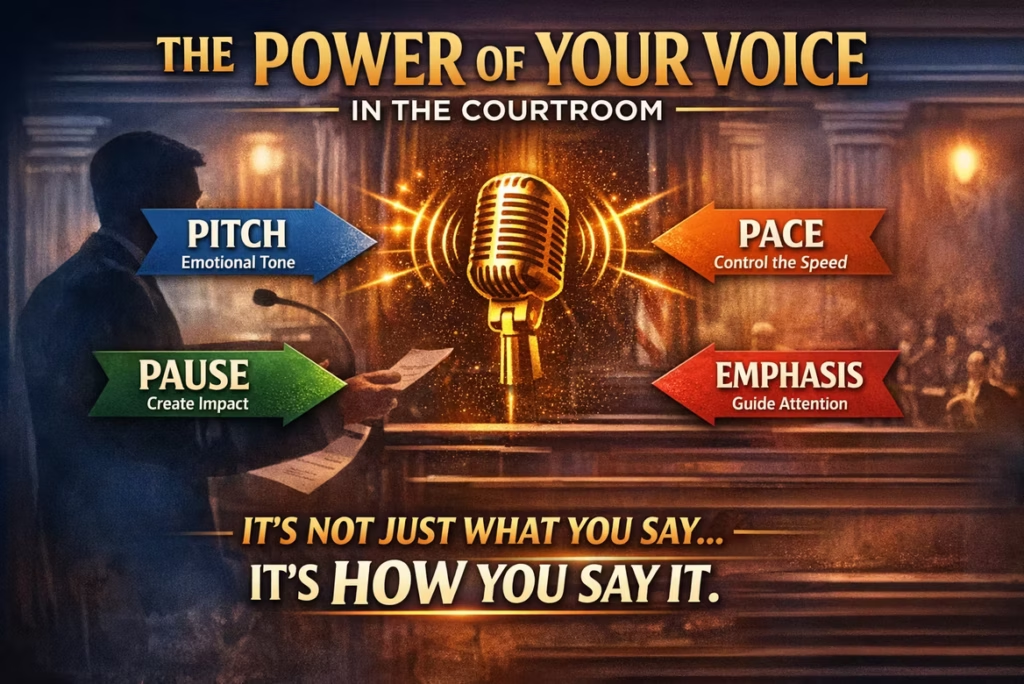
This article shows how to apply effective voice principles—pitch, pace, pause, and emphasis—in a way that transforms your opening from a recitation… into an experience.
Why Voice Matters More Than You Think
Jurors don’t just process information logically. They respond to:
-
Rhythm
-
Contrast
-
Emotional cues
-
Silence
A flat delivery forces jurors to work harder.A dynamic voice does the work for them.
The goal is not performance.
The goal is clarity that feels like truth.
The Four Voice Tools Every Trial Lawyer Must Master
1. Pitch: Your Emotional Register
Pitch is the rise and fall of your voice.
-
Lower pitch → seriousness, credibility
-
Higher pitch → urgency, tension
-
Mid-range → conversational storytelling
Used correctly, pitch allows you to signal emotion without saying it.
Instead of saying “this was serious,” your voice makes the jury feel that it was.
2. Pace: Control the Jury’s Attention
Pace is not just speed—it’s control.
-
Faster pace → action, chaos, unfolding events
-
Slower pace → importance, reflection, meaning
When everything is delivered at the same speed, nothing stands out.
But when you vary pace, you decide:
What the jury notices—and what they remember.
3. Pause: The Most Underrated Tool in Trial Advocacy
Most lawyers fear silence.
That’s a mistake.
A well-placed pause:
-
Signals importance
-
Allows ideas to land
-
Creates anticipation
But here’s the key:
You must earn the pause.
Overuse it, and you lose energy.Use it strategically, and you create impact.
4. Emphasis: Subtlety Wins
Jurors don’t like being told what to think.
They prefer to arrive there themselves.
That’s why emphasis must be light, not heavy-handed.
A slight stress on a word…A fractional pause before a phrase…
That’s enough.
Anything more feels like persuasion.And jurors resist persuasion they can see.
From Flat to Powerful: A Practical Example
The Typical Opening
“The evidence will show that the defendant was misidentified and was not present at the scene.”
Clear? Yes.Memorable? No.
The Same Idea—Using Voice
Now imagine delivering it this way:
“Ladies and gentlemen…this case… is about a mistake.”
Pause.
“A mistake… that felt certain… in the moment.”
Suddenly:
-
The jury leans in
-
The idea breathes
-
The theme lands
Nothing changed in substance.
Everything changed in delivery.
How Voice Shapes the Jury’s Experience
Think about what happens when voice is used effectively:
1. You Create Contrast
Fast vs. slowLoud vs. quietHigh vs. low
Contrast creates attention.
2. You Guide Without Forcing
Your voice highlights what matters—without announcing it.
This is critical.
Because the strongest persuasion is the kind the jury doesn’t notice.
3. You Build Credibility
Measured delivery signals control.
And control signals confidence.
And confidence—when quiet and restrained—reads as truth.
4. You Turn Information Into Story
Facts alone don’t persuade.
Experience does.
Voice is what converts one into the other.
The “Lighthouse” Principle
One of the most powerful ways to think about voice is this:
You are not pushing the jury. You are guiding them.
Like a lighthouse guiding a ship, your voice:
-
Illuminates key ideas
-
Signals direction
-
Keeps the jury oriented
If your emphasis is off, you don’t just lose clarity—
You risk guiding them somewhere you never intended.
Practical Tips You Can Use Immediately
Mark Your Openings
Don’t just write your opening—score it like music.
-
Pauses
-
Emphasis points
-
Changes in pace
Identify 3–5 Key Moments
Not every line deserves weight.
Choose:
-
Your theme
-
Your turning point
-
Your conclusion
Then build your vocal strategy around those moments.
Practice Out Loud (Not in Your Head)
Voice is physical.
You cannot refine it silently.
Eliminate the Monotone Trap
If everything sounds the same, nothing matters.
Force variation:
-
Slow down where it counts
-
Speed up where it moves
Respect the Pause
Before you pause, ask:
“Is this moment worth it?”
If yes—commit.
If not—keep moving.
The Bottom Line
A powerful opening statement is not just well-written.
It is well-delivered.
Because jurors don’t decide cases based on transcripts.
They decide based on:
-
What they felt
-
What they understood
-
What stayed with them
And all of that is shaped—profoundly—by your voice.
Final Thought
The next time you prepare an opening, don’t just ask:
“What am I going to say?”
Ask:
“How will the jury experience this?”
Because in the courtroom, your voice isn’t just a tool.
It’s the difference between being heard…
and being remembered.