Trial lawyers love facts.
Jurors love stories.
And the verdict is rendered by jurors—not lawyers.
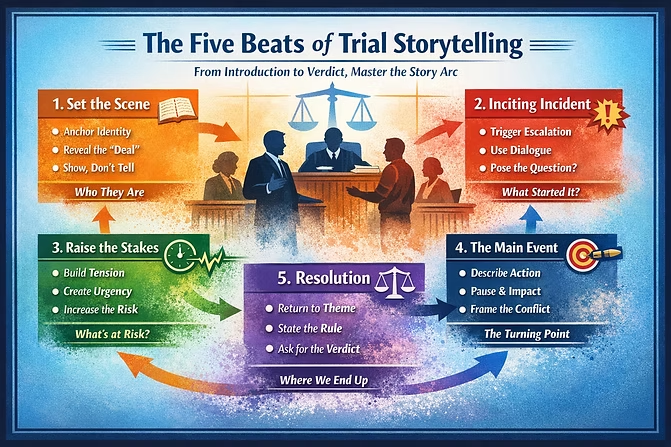
The Five Beats storytelling framework taught by Michael DeBlis III provides more than structure. It provides psychological sequencing. When used intentionally, it transforms an opening statement from a recitation of events into an experience jurors feel.
But structure alone isn’t enough.
The power lies in the rhetorical techniques embedded inside each beat.
Let’s break down how advanced courtroom storytellers deploy them.
Beat One: Set the Scene
Objective: Establish Identification Before Conflict
Beat One is not about the incident. It is about identity.
Jurors subconsciously ask:
“Who is this person—and do I recognize something human in them?”
Advanced Techniques
1. Identity Anchoring
Define your client before the accusation defines them.
Instead of:
“Daniel Ruiz is charged with aggravated assault.”
Try:
“Daniel Ruiz has never been arrested in his life.”
The first impression anchors perception. Behavioral science shows that once an identity is formed, jurors resist updating it.
Anchor wisely.
2. Controlled Vulnerability
Introduce the protagonist’s “deal”—the emotional or psychological tendency that will shape later choices.
“He freezes when confronted—until he doesn’t.”
Now jurors anticipate internal tension.
Flaw creates humanity. Humanity creates empathy.
3. Sensory Minimalism
Use one vivid detail, not five.
“Every Thursday, she lifted a baton.”
Specific beats general. Always.
4. Strategic Understatement
Over-description signals advocacy. Understatement signals credibility.
Weak:
“This was a devastating tragedy.”
Stronger:
“She dropped her baton.”
Let jurors supply emotion. They trust conclusions they reach themselves.
Delivery Guidance
Slow. Measured. Conversational. Beat One builds trust—not drama.
Beat Two: The Inciting Incident
Objective: Create Forward Motion
This is the moment the ordinary world breaks.
The jury’s brain shifts from observation to anticipation.
Advanced Techniques
1. Escalation Through Sentence Compression
Shorter sentences accelerate momentum.
He shoved him.
Daniel backed up.
He advanced.
Rhythm influences perception.
2. The Turning Line
A single line of dialogue can pivot the story.
“You don’t walk away from me.”
Dialogue makes it cinematic. The brain processes dialogue as lived experience.
3. Implied Choice Framing
Highlight the fork in the road.
“Now he had a choice.”
Choice creates agency. Agency creates engagement.
4. Plant the Story Question
Do not answer it.
Will she survive?
Was the fear reasonable?
Was the stroke preventable?
Suspense keeps jurors cognitively invested.
Delivery Guidance
Slightly faster pace. More energy.
You are moving the story forward.
Beat Three: Raising the Stakes
Objective: Deepen Emotional Investment
Most lawyers fail here.
They list additional facts instead of escalating consequences.
Raising stakes means increasing what can be gained—or lost.
Advanced Techniques
1. Interiorization
Move inside the character.
Instead of:
“He was afraid.”
Say:
“Imagine sitting in a parked car. The engine won’t start. Someone is pounding on the window.”
When jurors visualize, they emotionally simulate.
2. Contrast Amplification
Juxtapose calm and danger.
The ER was busy.
Brain cells were dying.
Parallel structure intensifies contrast.
3. Hindsight Separation
Especially critical in criminal defense.
“You now know he was unarmed. Daniel did not.”
This neutralizes outcome bias before it infects deliberations.
4. Escalation Tools
-
Time pressure (“By midnight…”)
-
Spatial narrowing (“All the way back to his car…”)
-
Isolation (“No CT scan. No neurologist. No alert.”)
Escalation must feel inevitable—not manufactured.
Delivery Guidance
Let silence work.
Pause after high-stakes moments.
Tension needs oxygen.
Beat Four: The Main Event
Objective: Deliver the Emotional Turning Point
This is the pivot.
The biggest mistake lawyers make here. Over-talking it.
The climax must be clean.
Advanced Techniques
1. Linguistic Simplicity
Shortest sentences in the entire opening.
The door opens.
He fires once.
Silence.
Minimalism maximizes impact.
2. The Controlled Pause
After the pivotal sentence—stop.
Let it land.
Silence amplifies gravity.
3. Immediate Reframing
Acknowledge the hard fact before opposing counsel does.
“The question is not whether a shot was fired. It was.”
Credibility increases.
Then define the real issue:
“The question is whether the fear was reasonable.”
You shift the battlefield.
4. Irreversibility Language
“Life split into two versions—before and after.”
Irreversibility increases emotional weight.
Delivery Guidance
Lower your voice. Slow down. Make eye contact.
The courtroom should feel smaller in this moment.
Beat Five: Resolution
Objective: Provide Moral Clarity and Decision Pathway
Beat Five is not summary.
It is meaning.
Advanced Techniques
1. Circular Structure
Return to an image from Beat One.
If you began with:
“She was a conductor.”
End with:
“Today, she listens.”
Closure creates memorability.
2. Principle Framing
Zoom out to a governing rule.
“The law does not require perfect judgment.”
“In stroke care, time is brain.”
Jurors like rules. Rules feel objective.
3. Binary Framing
Reduce cognitive strain.
Aggression—or survival?
A bad outcome—or a missed chance?
Binary framing simplifies deliberation architecture.
4. Calm Verdict Request
Do not crescendo emotionally at the end.
Confidence persuades more than passion.
Delivery Guidance
Steady. Grounded. Unhurried.
The verdict should feel inevitable—not demanded.
The Meta-Layer: Techniques That Span All Five Beats
Strategic Repetition (Motif)
Subtle repetition wires memory.
Time matters.
Time was passing.
Time was lost.
Jurors remember rhythm.
Narrative Economy
One vivid detail per beat.
Excess detail kills arc.
Emotional Modulation
Think in waves:
-
Beat One: Calm
-
Beat Two: Rising
-
Beat Three: Tight
-
Beat Four: Sharp
-
Beat Five: Settled
Monotone storytelling flattens persuasion.
Juror Self-Insertion
Used sparingly:
“Imagine sitting in that car…”
Visualization increases identification.
Why This Works
Jurors are not spreadsheets.
They process:
-
Orientation
-
Disruption
-
Escalation
-
Decision
-
Meaning
The Five Beats mirror how humans encode memory and evaluate threat.
And verdicts are memory-driven decisions.
Final Thought for Trial Lawyers
Facts inform.
Structure organizes.
But narrative persuades.
If you structure your opening around legal elements, jurors will listen.
If you structure it around emotional inevitability, jurors will lean forward.
And when jurors lean forward, they are already halfway to your verdict.