The Five Beats That Win Verdicts: Advanced Storytelling Techniques for Trial Attorneys
Trial lawyers love facts.


Jurors love stories.


And the verdict is rendered by jurors—not lawyers.


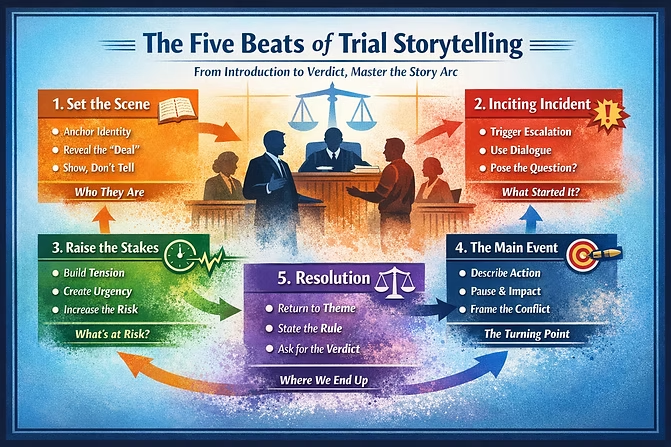
The Five Beats storytelling framework taught by Michael DeBlis III provides more than structure. It provides psychological sequencing. When used intentionally, it transforms an opening statement from a recitation of events into an experience jurors feel.

But structure alone isn’t enough.


The power lies in the rhetorical techniques embedded inside each beat.


Let’s break down how advanced courtroom storytellers deploy them.

Beat One: Set the Scene


Objective: Establish Identification Before Conflict


Beat One is not about the incident. It is about identity.


Jurors subconsciously ask:


“Who is this person—and do I recognize something human in them?”


Advanced Techniques


1. Identity Anchoring


Define your client before the accusation defines them.


Instead of:


“Daniel Ruiz is charged with aggravated assault.”


Try:


“Daniel Ruiz has never been arrested in his life.”


The first impression anchors perception. Behavioral science shows that once an identity is formed, jurors resist updating it.


Anchor wisely.

2. Controlled Vulnerability


Introduce the protagonist’s “deal”—the emotional or psychological tendency that will shape later choices.


“He freezes when confronted—until he doesn’t.”


Now jurors anticipate internal tension.


Flaw creates humanity. Humanity creates empathy.

3. Sensory Minimalism


Use one vivid detail, not five.


“Every Thursday, she lifted a baton.”


Specific beats general. Always.

4. Strategic Understatement


Over-description signals advocacy. Understatement signals credibility.


Weak:


“This was a devastating tragedy.”


Stronger:


“She dropped her baton.”


Let jurors supply emotion. They trust conclusions they reach themselves.

Delivery Guidance


Slow. Measured. Conversational. Beat One builds trust—not drama.

Beat Two: The Inciting Incident


Objective: Create Forward Motion


This is the moment the ordinary world breaks.


The jury’s brain shifts from observation to anticipation.


Advanced Techniques


1. Escalation Through Sentence Compression


Shorter sentences accelerate momentum.


He shoved him.

Daniel backed up.

He advanced.


Rhythm influences perception.

2. The Turning Line


A single line of dialogue can pivot the story.


“You don’t walk away from me.”


Dialogue makes it cinematic. The brain processes dialogue as lived experience.

3. Implied Choice Framing


Highlight the fork in the road.


“Now he had a choice.”


Choice creates agency. Agency creates engagement.

4. Plant the Story Question


Do not answer it.


Will she survive?

Was the fear reasonable?

Was the stroke preventable?


Suspense keeps jurors cognitively invested.

Delivery Guidance


Slightly faster pace. More energy.

You are moving the story forward.

Beat Three: Raising the Stakes


Objective: Deepen Emotional Investment


Most lawyers fail here.


They list additional facts instead of escalating consequences.


Raising stakes means increasing what can be gained—or lost.

Advanced Techniques


1. Interiorization


Move inside the character.


Instead of:


“He was afraid.”


Say:


“Imagine sitting in a parked car. The engine won’t start. Someone is pounding on the window.”


When jurors visualize, they emotionally simulate.

2. Contrast Amplification


Juxtapose calm and danger.


The ER was busy.

Brain cells were dying.


Parallel structure intensifies contrast.

3. Hindsight Separation


Especially critical in criminal defense.


“You now know he was unarmed. Daniel did not.”


This neutralizes outcome bias before it infects deliberations.

4. Escalation Tools

 
  • Time pressure (“By midnight…”)

  • Spatial narrowing (“All the way back to his car…”)

  • Isolation (“No CT scan. No neurologist. No alert.”)


Escalation must feel inevitable—not manufactured.

Delivery Guidance


Let silence work.

Pause after high-stakes moments.

Tension needs oxygen.

Beat Four: The Main Event


Objective: Deliver the Emotional Turning Point


This is the pivot.


The biggest mistake lawyers make here. Over-talking it.


The climax must be clean.

Advanced Techniques


1. Linguistic Simplicity


Shortest sentences in the entire opening.


The door opens.

He fires once.

Silence.


Minimalism maximizes impact.

2. The Controlled Pause


After the pivotal sentence—stop.


Let it land.


Silence amplifies gravity.

3. Immediate Reframing


Acknowledge the hard fact before opposing counsel does.


“The question is not whether a shot was fired. It was.”


Credibility increases.


Then define the real issue:


“The question is whether the fear was reasonable.”


You shift the battlefield.

4. Irreversibility Language


“Life split into two versions—before and after.”


Irreversibility increases emotional weight.

Delivery Guidance


Lower your voice. Slow down. Make eye contact.


The courtroom should feel smaller in this moment.

Beat Five: Resolution


Objective: Provide Moral Clarity and Decision Pathway


Beat Five is not summary.


It is meaning.

Advanced Techniques


1. Circular Structure


Return to an image from Beat One.


If you began with:


“She was a conductor.”


End with:


“Today, she listens.”


Closure creates memorability.

2. Principle Framing


Zoom out to a governing rule.


“The law does not require perfect judgment.”


“In stroke care, time is brain.”


Jurors like rules. Rules feel objective.

3. Binary Framing


Reduce cognitive strain.


Aggression—or survival?

A bad outcome—or a missed chance?


Binary framing simplifies deliberation architecture.

4. Calm Verdict Request


Do not crescendo emotionally at the end.


Confidence persuades more than passion.

Delivery Guidance


Steady. Grounded. Unhurried.


The verdict should feel inevitable—not demanded.

The Meta-Layer: Techniques That Span All Five Beats

Strategic Repetition (Motif)


Subtle repetition wires memory.


Time matters.

Time was passing.

Time was lost.


Jurors remember rhythm.

Narrative Economy


One vivid detail per beat.


Excess detail kills arc.

Emotional Modulation


Think in waves:

 
  • Beat One: Calm

  • Beat Two: Rising

  • Beat Three: Tight

  • Beat Four: Sharp

  • Beat Five: Settled


Monotone storytelling flattens persuasion.

Juror Self-Insertion


Used sparingly:


“Imagine sitting in that car…”


Visualization increases identification.

Why This Works


Jurors are not spreadsheets.


They process:

 
  1. Orientation

  2. Disruption

  3. Escalation

  4. Decision

  5. Meaning


The Five Beats mirror how humans encode memory and evaluate threat.


And verdicts are memory-driven decisions.

Final Thought for Trial Lawyers


Facts inform.


Structure organizes.


But narrative persuades.


If you structure your opening around legal elements, jurors will listen.


If you structure it around emotional inevitability, jurors will lean forward.


And when jurors lean forward, they are already halfway to your verdict.
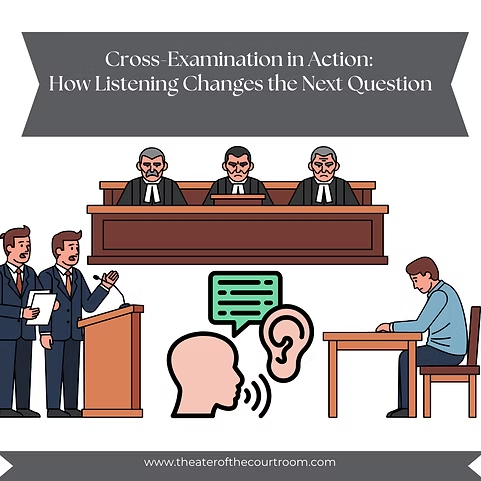
Cross-Examination in Action: How Listening Changes the Next Question

Below are practical examples showing how each type of listening directly shapes the very next cross-examination question. These are moments where disciplined listening—not scripted questions—creates leverage.


1. Informational Listening → Precision Follow-Up

Witness: “I arrived at the scene around 10:00 p.m.”

What the lawyer hears (informational): – “Around” (approximation) – Potential uncertainty in timing

Next question shaped by listening: > “When you say around 10:00 p.m., could it have been closer to 10:15?”

Why it works: The lawyer exploits imprecision rather than assuming certainty. This small adjustment can later unravel timelines in closing.


2. Analytical Listening → Structural Breakdown

Witness: “Based on my experience, that behavior indicates intent.”

What the lawyer hears (analytical): – Conclusion offered without articulated foundation

Next question shaped by listening: > “What specific behavior are you relying on to reach that conclusion?”

Follow-up: > “And there’s nothing in your training that says that behavior always means intent, correct?”

Why it works: The lawyer exposes the gap between facts and opinion without argument or hostility.


3. Strategic Listening → Delayed Attack

Witness: “I never lost sight of the defendant.”

What the lawyer hears (strategic): – Absolute language (“never”) – High impeachment value later

Next decision shaped by listening: – No immediate challenge

Later cross-examination: > “You testified earlier that you never lost sight of him. That was your testimony, correct?” > > “But you also told the officer your view was blocked for several seconds, didn’t you?”

Why it works: Strategic listening recognizes when restraint creates a stronger contradiction.


4. Empathic Listening → Tone Adjustment

Witness: “I was terrified. I didn’t know what was going to happen.”

What the lawyer hears (empathic): – Fear, not exaggeration

Next question shaped by listening: > “And when people are scared, it can affect what they think they see, correct?”

Why it works: The lawyer reframes perception without attacking credibility, preserving jury goodwill.


5. Judicial Listening → Course Correction

Judge: “Counsel, let’s move along.”

What the lawyer hears (judicial): – Impatience with detail

Next question shaped by listening: > “You did not actually see who threw the first punch, correct?”

Why it works: The lawyer shortens the examination while landing the critical concession.


6. Jury-Centered Listening → Clarification

Witness: “The accelerant caused a flashover event.”

What the lawyer hears (jury-centered): – Technical jargon likely confusing jurors

Next question shaped by listening: > “In plain English, that means the fire spread suddenly and unpredictably, right?”

Why it works: The lawyer becomes the jury’s translator, building trust and clarity.


7. Self-Listening → Regaining Control

Lawyer (internally): Notices voice rising, pacing increasing

What the lawyer hears (self-listening): – Loss of control signals

Next adjustment: > Pause. > > “Let me slow this down. You answered ‘yes’ to that question, correct?”

Why it works: Control of tone restores authority and keeps the jury focused on substance, not emotion.

Conclusion: Listening Is a Tactical Advantage

These examples illustrate a core truth of trial practice: the best cross-examinations are built in real time. Scripted questions may start the process, but disciplined listening determines how it ends.

Trial lawyers who listen well do not merely respond—they shape testimony, guide perception, and create record. In the courtroom, listening is not passive. It is power.

Listening as Advocacy: How Trial Attorneys Can Use Different Types of Listening in the Courtroom


Trial lawyers are trained extensively in speaking—opening statements, examinations, objections, and closing arguments. Far less attention is paid to listening. Yet in trial practice, listening is not passive. It is an active, strategic skill that directly shapes examinations, objections, credibility, and persuasion.


Great trial attorneys listen differently than ordinary participants in a conversation. They listen with purpose, discipline, and intention. Understanding the different types of listening—and knowing when to deploy each—can materially improve courtroom performance.


1. Informational Listening: Hearing the Facts Beneath the Words


What it is: Informational listening focuses on accurately receiving and processing factual content. The goal is comprehension, not evaluation or rebuttal.

Where it matters in trial: – Direct examination of witnesses – Opposing counsel’s questions – Judicial instructions, rulings, and comments – Expert testimony

How trial attorneys should use it:

Trial lawyers often listen only for the moment they can object or respond. Informational listening requires resisting that impulse. Instead, the attorney listens carefully to:

·       Exact word choices

·       Chronology

·       Quantifiers (“always,” “never,” “sometimes”)

·       Unintended admissions or inconsistencies

This type of listening allows counsel to: – Catch misstatements in real time – Spot openings for follow-up questions – Preserve issues for impeachment or closing

Practice tip: During witness preparation, discipline yourself to not write your next question while the witness is speaking. Listen fully first; then decide whether to pivot, press, or move on.


2. Analytical (Critical) Listening: Evaluating Credibility and Structure


What it is: Analytical listening evaluates the logic, coherence, and reliability of what is being said.

Where it matters in trial: – Cross-examination – Expert testimony – Prosecutorial or opposing counsel arguments – Bench conferences

How trial attorneys should use it:

Here, the lawyer listens for: – Internal contradictions – Unsupported conclusions – Gaps between facts and opinions – Assumptions masquerading as evidence

Analytical listening enables the attorney to dismantle testimony methodically rather than emotionally. Instead of reacting to what is said, the lawyer evaluates how it is constructed.

This is especially critical when dealing with experts. The most effective cross-examinations arise not from memorized attacks, but from listening carefully to how an expert explains—or avoids explaining—their methodology.

Practice tip: Ask yourself silently: Does this answer actually support the conclusion being offered? If not, that gap becomes your next question.


3. Strategic Listening: Anticipating the Next Move


What it is: Strategic listening focuses on where testimony or argument is headed and how it fits into the broader theory of the case.

Where it matters in trial: – Opening statements – Long narrative answers – Redirect examination – Closing arguments

How trial attorneys should use it:

Trial lawyers must listen with the end in mind. Strategic listening asks:

·       How does this testimony advance or undermine the opposing theory?

·       What will the jury remember from this?

·       How can this be reframed later?

This form of listening allows counsel to make real-time decisions—whether to object, let an answer linger, or save it for closing.

Not every damaging answer should be challenged immediately. Strategic listening recognizes that some testimony is best neutralized later, when context and perspective can be restored.

Practice tip: If an answer hurts you, pause mentally and ask: Is now the best moment to fight this—or is later better?


4. Empathic Listening: Understanding the Human Element


What it is: Empathic listening seeks to understand emotions, motivations, and perspective—without necessarily agreeing.

Where it matters in trial: – Direct examination of your own client – Cross-examination of sympathetic witnesses – Victim testimony – Sentencing hearings

How trial attorneys should use it:

Jurors and judges are acutely sensitive to tone. Empathic listening allows the attorney to:

·       Adjust questioning style in real time

·       Avoid appearing cruel or dismissive

·       Build rapport and credibility

This is especially important when examining vulnerable witnesses. An attorney who listens empathically can control the courtroom without alienating the factfinder.

Empathy also informs strategy. Understanding why a witness believes something often reveals how that belief can be respectfully challenged.

Practice tip: Match your pacing and tone to the witness’s emotional state before gradually steering them where you need to go.


5. Judicial Listening: Listening for Signals from the Bench


What it is: Judicial listening focuses on the court’s reactions—verbal and nonverbal—to what is happening in the courtroom.

Where it matters in trial: – Objections and rulings – Bench trials – Sentencing hearings – Motion practice during trial

How trial attorneys should use it:

Judges constantly communicate preferences through: – Interruptions – Follow-up questions – Body language – Tone of rulings

An attorney who listens carefully to the court can adapt instantly—shortening arguments, reframing objections, or changing examination style.

Ignoring these signals risks irritating the court and undermining credibility.

Practice tip: Treat every ruling as information. Even an adverse ruling tells you how the judge is thinking.


6. Jury-Centered Listening: Hearing What the Jury Is Hearing


What it is: Jury-centered listening involves monitoring how testimony and argument likely land with jurors.

Where it matters in trial: – All phases of trial, especially openings and witness examinations

How trial attorneys should use it:

Listen with a juror’s ear: – Is this confusing? – Is this boring? – Is this emotionally off-putting?

Trial lawyers often overestimate how much jurors understand or remember. Jury-centered listening keeps counsel grounded in clarity and persuasion.

Practice tip: If you find yourself confused, the jury probably is too.


7. Self-Listening: Monitoring Your Own Advocacy


What it is: Self-listening is awareness of your own tone, pace, and word choices.

Where it matters in trial: – Cross-examination – Arguments to the court – High-stakes objections

How trial attorneys should use it:

Listening to yourself helps prevent: – Escalation – Sarcasm – Loss of control

The most effective advocates sound calm and intentional—even under pressure.

Practice tip: If your voice rises, slow down. Control of self precedes control of the courtroom.

You Can’t Handle the Truth—But You Can Cross-Examine It: What Hollywood Courtroom Showdowns Still Teach Trial Lawyers


Trial lawyers love courtroom dramas for the same reason jurors do: conflict, control, and revelation. But beneath the theatrics, the best courtroom scenes in film and television endure because they model core truths about cross-examination—how witnesses unravel, how jurors decide credibility, and how advocacy is often more about timing and restraint than clever questions.

Hollywood exaggerates. Real courtrooms impose rules. Yet when you strip away the music, the camera angles, and the climactic speeches, many iconic cross-examinations still function as useful teaching laboratories for trial attorneys.


What follows is a practitioner-focused breakdown of twelve of the most famous courtroom cross-examination scenes ever filmed—translated into real-world advocacy lessons you can actually use. Each scene is broken down beat‑by‑beat to show objective, structure, psychological leverage, risk, and real‑world courtroom application. The goal is not imitation—but translation.

1. A Few Good Men: When Cross-Examination Is About Behavior, Not Answers


Kaffee v. Jessup


The climactic cross of Colonel Jessup is not effective because of a “gotcha” question. It’s effective because defense counsel engineers a loss of self-control.


The questioning starts small, almost deferential. Authority is confirmed. Responsibility is repeated. Pressure builds through repetition, not aggression. Only after the witness is publicly committed does the provocation come—and when it does, the witness supplies the missing element himself.


Objective

Force a powerful witness to abandon discipline and reveal the truth through loss of control.


Beats

  1. Underplay the Threat

  2. Establish Authority

  3. Repetition as Pressure

  4. Moral Provocation

  5. Public Cornering

  6. Emotional Detonation

  7. Silence After the Explosion


Advocacy Lessons

  • Cross can be about behavior, not answers.

  • Escalation must be earned.

  • Cross can be about behavioral collapse, not answers.

  • Escalation must be earned—never rushed.

  • The jury believes what they see, not what you argue.


Trial takeaway:Sometimes the most important evidence is demeanor. Cross-examination can be about creating a moment the jury cannot unsee.

2. To Kill a Mockingbird: The Power of Gentle Cross


Atticus Finch v. Mayella Ewell


Atticus Finch never humiliates Mayella Ewell. He doesn’t accuse. He doesn’t argue. He simply asks about physical facts—who used which hand, where injuries appeared—and allows the jury to reach the conclusion on its own.


The cross works because it respects the witness, even while dismantling the accusation.


Objective

Expose implausibility without humiliating a vulnerable witness.


Beats

  1. Radical Courtesy – Atticus’s politeness contrasts with the prosecution’s aggression.

  2. Physical Detail – He focuses on injuries, not accusations.

  3. Incremental Logic – Each fact quietly contradicts the state’s theory.

  4. Unasked Question – Atticus never accuses; he provides room for discovery so that the conclusion forms in the jurors’ minds.

  5. Moral Pause – He allows the jury to feel the injustice rather than declare it.


Advocacy Lessons

  • Gentle cross can be devastating.

  • Jurors resent cruelty toward weak witnesses.

  • Silence is sometimes the strongest impeachment.


Trial takeaway:Jurors punish cruelty. When a witness is vulnerable, restraint becomes credibility.

3. My Cousin Vinny: Expert Witnesses Fall to Common Sense


Vinny Gambini v. Mona Lisa Vito


The famous tire-mark cross succeeds not because of technical brilliance, but because it translates expertise into everyday reality. The expert’s credentials are unimpeachable—but once the science is explained in plain language, the conclusion becomes inevitable.


Objective

Reframe expert testimony using plain language and common experience.


Beats

  1. Credential Shock – The expert’s qualifications disarm skepticism.

  2. Common-Sense Premise – The cross rests on lived reality, not jargon.

  3. Visual Imagination – Jurors can see the tire marks.

  4. Binary Questioning – Each answer forces agreement with physics.

  5. Irreversible Conclusion – Once the logic clicks, no rebuttal is possible.


Advocacy Lessons

  • Expertise must be understandable to be persuasive.

  • Humor increases retention—but only when the logic is airtight.


Trial takeaway:If jurors can’t explain the expert’s opinion to each other during deliberations, you haven’t really impeached it.

4. Witness for the Prosecution: The Value of Delayed Impeachment


Sir Wilfrid Robarts v. Christine Vole


This classic reminds us that not every cross should reveal its purpose immediately. By allowing the witness to overcommit, the examiner makes the eventual contradiction catastrophic rather than incremental.


Objective

Test the reliability of the witness while concealing the true strategy.


Beats

  1. Apparent Submission – Robarts seems outmatched.

  2. False Confidence – The witness overcommits to her narrative.

  3. Delayed Contradiction – Impeachment is saved for maximum effect.

  4. Identity Shift – The jury realizes the witness’s role is not what it seemed.

  5. Perspective Reversal – Credibility collapses all at once.


Advocacy Lessons

  • Cross need not reveal its purpose immediately.

  • Let witnesses trap themselves.


Trial takeaway:You don’t always need to win early. Sometimes the most effective impeachment is the one the jury never sees coming.

5. Primal Fear: Watching the Witness, Not the Outline


Martin Vail v. Aaron Stampler


The cross-examination turns not on a document or prior statement, but on a behavioral shift the jury notices before counsel fully articulates it. The witness changes—and once the jury sees it, the entire theory collapses.


Objective

Expose the unreliability of the defense’s own narrative.


Beats

  1. Comfort Zone – Vail reassures the witness.

  2. Trigger Introduction – Emotional stimuli provoke inconsistency.

  3. Micro-Contradictions – Small slips accumulate.

  4. Behavioral Shift – The jury sees a change before understanding it.

  5. Theory Collapse – The defense story implodes in real time.


Advocacy Lessons

  • Cross can be dangerous—even to your own case.

  • Watch the witness more than your outline.


Trial takeaway:Great cross-examiners watch the witness more than their notes. Jurors pick up on changes instantly.

6. The Verdict: The Art of Knowing When to Stop


Frank Galvin v. Dr. Towler


Few scenes capture the discipline of cross better than Paul Newman’s spare questioning of a medical expert. The witness volunteers too much. One precise question reframes everything. Then counsel stops.


Objective

Undermine an expert’s authority using restraint.


Beats

  1. Minimalism – Galvin asks very little.

  2. Expert Overconfidence – The witness volunteers damaging explanations.

  3. Precision Question – One narrow question reframes the testimony.

  4. Strategic Stop – Galvin ends before repair is possible.


Advocacy Lessons

  • Fewer questions equal fewer escape routes.

  • Experts often defeat themselves if given room.


Trial takeaway:Every additional question risks repair. The hardest skill in cross-examination is ending it at the right moment.

7. Philadelphia: Proving Bias Without Saying the Word


Joe Miller v. Law Firm Partners


Bias is never alleged directly. Instead, a pattern of decisions emerges—who was treated one way, who another. The witnesses grow uncomfortable. The jury connects the dots.


Objective

Reveal discrimination without overt accusation.


Beats

  1. Professional Neutrality – Miller avoids moralizing.

  2. Pattern Recognition – Decisions reveal bias when grouped.

  3. Tone Shift – The jury feels injustice before hearing it named.

  4. Witness Discomfort – Credibility erodes through demeanor.


Advocacy Lessons

  • Bias is best proven indirectly.

  • Jurors trust patterns more than labels.


Trial takeaway:Jurors trust patterns more than labels. Let them name the injustice themselves.

8. Inherit the Wind: Putting Ideas on Trial


Henry Drummond v. Matthew Brady


This cross is less about facts than belief systems. By forcing a witness into absolutist positions, counsel exposes how those beliefs collapse under hypotheticals.


Objective

Put belief systems—not facts—on trial.


Beats

  1. Foundational Agreement – Shared values are established.

  2. Literalism Trap – The witness commits to absolutes.

  3. Hypothetical Stress Test – Beliefs fail under scrutiny.

  4. Public Realization – The jury witnesses intellectual collapse.


Advocacy Lessons

  • Cross can interrogate ideas.

  • Absolutes are inherently vulnerable.


Trial takeaway:Cross-examination can test ideas, not just testimony. Absolutes are fragile under scrutiny.

9. Law & Order: The Virtue of Efficiency


Television’s most durable legal franchise models something real lawyers often forget: brevity. One fact. One contradiction. Immediate impeachment. Exit.


Objective

Model efficient, modern impeachment.


Beats

  1. Single-Fact Focus

  2. Immediate Impeachment

  3. No Commentary

  4. Rapid Exit


Advocacy Lessons

  • Jurors respect discipline.

  • Cross is not closing argument.


Trial takeaway:Cross is not closing argument. Commentary dilutes impact.

10. The Practice / Boston Legal: Style as a Force Multiplier—and a Risk


Aggressive crosses can destabilize witnesses quickly, but they walk a fine line. When style outpaces substance, jurors recoil.


Objective

Use controlled aggression to destabilize witnesses.


Beats

  1. Dominance Establishment

  2. Ethical Line Testing

  3. Emotional Pressure

  4. Narrative Hijacking


Advocacy Lessons

  • Style magnifies substance.

  • Overreach risks backlash.


Trial takeaway:Personality amplifies technique—but also magnifies mistakes.

11. And Justice for All: When Advocacy Becomes About the Lawyer


Arthur Kirkland v. Himself


The courtroom breakdown is powerful cinema, but instructive for a different reason. The jury’s attention shifts from evidence to counsel.


Objective

Expose systemic injustice.


Beats

  1. Suppressed Conflict

  2. Incremental Frustration

  3. Public Breakdown

  4. Moral Verdict


Advocacy Lessons

  • Credibility includes self-control.

  • Emotional authenticity cuts both ways.


Trial takeaway:Authenticity matters, but self-control is part of credibility. Jurors are always evaluating the lawyer.

12. A Civil Action: Winning by Attrition


This is not a flashy cross. It’s document-heavy, methodical, and exhausting. Concessions accumulate. Fatigue sets in. The narrative emerges slowly—but decisively.


Objective

Wear down institutional witnesses.


Beats

  1. Document Mastery

  2. Incremental Concessions

  3. Attritional Fatigue

  4. Narrative Accumulation


Advocacy Lessons

  • Persistence persuades.

  • Jurors track effort as truth.


Trial takeaway:Persistence persuades. Jurors notice who did the work.

Final Thought: Hollywood Gets One Thing Right


Real trials are quieter than movies. Judges interrupt. Objections land. Witnesses rarely confess. But Hollywood consistently captures one essential truth:


Cross-examination is about human behavior under pressure.


Whether through restraint or escalation, silence or repetition, humor or discipline, the best crosses—on screen and in court—create moments jurors remember when they deliberate.

And in the end, that’s the only verdict that matters.

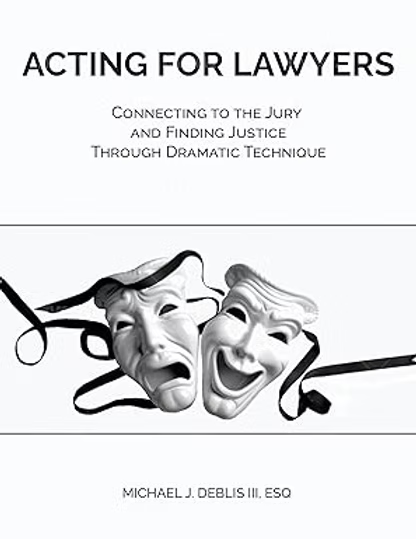
Acting for Lawyers: Connecting to the Jury & Finding Justice Through Dramatic Technique

What if the most powerful trial skill isn’t legal knowledge—but presence?


In Acting for Lawyers, trial attorney and trained actor Michael DeBlis III, Esq. reveals how the core tools of professional actors—embodiment, voice, intention, listening, and emotional truth—can dramatically elevate courtroom advocacy.


Drawing from years as a public defender handling high-stakes felony trials and formal training in acting and performance psychology, DeBlis bridges the gap between legal analysis and human connection. This book is not about theatrics or putting on a show. It is about truthful performance—showing up with credibility, authenticity, and command when it matters most.


Trial lawyers already understand the law. What often separates persuasive advocates from forgettable ones is how they inhabit the courtroom.


This book shows you how.


Inside, you’ll learn how to:

 
  • Use acting principles to enhance credibility without sounding rehearsed

  • Harness body language, movement, and stillness to project authority and confidence

  • Develop vocal control and emotional range to keep judges and juries engaged

  • Stay fully present under pressure through listening-based advocacy

  • Avoid “over-acting” while still delivering compelling openings, examinations, and arguments

  • Access authentic emotion without manipulation or performance gimmicks


Rather than scripts or canned techniques, Acting for Lawyers provides a practical framework for embodied advocacy—helping lawyers align their words, voice, and physical presence so that jurors don’t just hear the argument, they feel it.


Who this book is for:

 
  • Trial lawyers and litigators at any stage of practice

  • Criminal defense and civil trial attorneys

  • Law students preparing for trial advocacy or moot court

  • Attorneys seeking to improve courtroom presence, confidence, and persuasion


If you’ve ever felt that your arguments were solid—but your delivery didn’t land the way you intended—this book will change how you think about advocacy forever.


Because in the courtroom, credibility is not just argued. It is performed.

Sentencing Joe Goldberg: Mitigation When the Monster Is Human

What Criminal Defense Attorneys Can Learn from Netflix’s You


Premise: Assume Joe Goldberg—the obsessive, lethal protagonist of You—has been charged with all known killings, convicted after trial, and now stands before the court for sentencing. The question is no longer guilt. The question is meaning—and mitigation.


For criminal defense attorneys, Joe presents the most uncomfortable client imaginable: intelligent, manipulative, superficially charming, and profoundly dangerous. Yet sentencing is not a referendum on likability. It is a constitutional moment requiring individualized justice. Even monsters are sentenced as human beings.


This article explores how a defense attorney could marshal mitigation for Joe at sentencing—particularly through psychiatric evaluation—without excusing his conduct, minimizing victims, or insulting the court’s intelligence.

I. The Sentencing Posture: When the Verdict Is In


By the time Joe reaches sentencing, several realities shape the advocacy:

 
  • The fact-finder has already rejected defenses of justification, insanity, or diminished capacity.

  • The record likely reflects calculated, repeated acts of violence.

  • The court may be weighing life imprisonment, consecutive sentences, or the functional equivalent of death by incarceration.


Mitigation, therefore, must do three things:

 
  1. Explain without excusing

  2. Humanize without sentimentalizing

  3. Contextualize risk without denying it


Joe’s past—and his pathology—allow for all three.

II. Joe Goldberg’s Developmental History as Mitigation


A sentencing court may consider a defendant’s life history insofar as it bears on culpability, character, and prospects for containment.


A. Severe Childhood Trauma and Attachment Disruption


Joe’s canonical background includes:

 
  • Chronic childhood abuse

  • Exposure to intimate partner violence

  • Early abandonment and institutional neglect

  • A lack of stable, prosocial attachment figures


Mitigation Argument: Joe’s emotional development arrested at a pre-adolescent stage. His later violence reflects maladaptive survival strategies formed in a world where control equaled safety and intimacy equaled threat.


A defense attorney would argue that Joe did not simply “choose evil,” but rather matured inside an environment that neurologically and psychologically conditioned him toward hypervigilance, possessiveness, and emotional dysregulation.

III. The Central Pillar: A Comprehensive Psychiatric Evaluation


Because Joe exhibits sociopathic tendencies, psychiatric mitigation must be precise, credible, and scientifically grounded.


A. Likely Diagnostic Findings


A qualified forensic psychiatrist might identify:


1. Antisocial Personality Disorder (ASPD)


Relevant findings may include:

 
  • Persistent disregard for the rights of others

  • Deceitfulness and manipulation

  • Lack of conventional remorse (though capable of cognitive empathy)

  • Impulsivity coupled with instrumental violence


Mitigating Relevance: While ASPD does not excuse criminal conduct, courts have recognized that personality disorders can reduce moral blameworthiness by impairing behavioral inhibition and long-term consequence processing.


Importantly, Joe’s violence is not sadistic chaos—it is goal-oriented, relationship-driven, and rooted in distorted attachment needs.


2. Complex Post-Traumatic Stress Disorder (C-PTSD)


A psychiatrist may find:

 
  • Intrusive trauma-related ideation

  • Emotional numbing alternating with hyperarousal

  • Dissociative episodes during stress

  • Maladaptive bonding behaviors


Mitigating Relevance: C-PTSD reframes Joe’s obsession and violence as trauma reenactment rather than pure predation—an attempt to control abandonment before it occurs.


3. Attachment Disorder with Disorganized Features


Findings could include:

 
  • Pathological fear of abandonment

  • Fusion of love with control

  • Inability to mentalize others as independent agents


Mitigating Relevance: This disorder explains Joe’s cognitive distortions—particularly his belief that violence can preserve intimacy. While dangerous, this pathology reflects psychological injury, not inherent cruelty.

IV. Specific Psychiatric Findings Relevant to Sentencing


A strong mitigation report would contain concrete, sentencing-relevant conclusions, such as:

 
  • Joe’s capacity for impulse control is significantly compromised under perceived relational threat

  • His violence is situationally triggered rather than globally predatory

  • He demonstrates intact intellectual functioning but impaired affective regulation

  • He is not psychotic, but his moral reasoning is developmentally stunted


These findings matter because they:

 
  • Distinguish Joe from indiscriminate killers

  • Support structured containment over pure retribution

  • Undercut the narrative of gratuitous evil

V. Remorse, Insight, and the Problem of the Sociopath


Joe’s lack of traditional remorse is not disqualifying.


A psychiatrist might testify that:

 
  • Joe experiences cognitive remorse (understanding harm) without emotional resonance

  • His expressions of care are sincere within a distorted framework

  • His self-justifications are defensive, not purely manipulative


Mitigation Strategy: The defense reframes remorse as capacity for insight. Joe may never feel what others feel—but he can understand rules, consequences, and containment.

VI. Risk Assessment and Containment-Based Sentencing


Sentencing courts care deeply about future danger.


A mitigation expert could opine:

 
  • Joe poses a high risk in unstructured environments

  • His risk significantly decreases in highly controlled, supervised settings

  • He is amenable to long-term institutional management, even if not “rehabilitation”


This supports arguments against maximum consecutive sentencing where life-without-hope is not statutorily mandated.

VII. The Defense Attorney’s Ethical Tightrope


Mitigating Joe is not about sympathy—it is about fidelity to the law.


The defense attorney does not:

 
  • Minimize victims

  • Blame society

  • Ask the court to ignore danger


Instead, counsel asks the court to:


Sentence Joe Goldberg for who he is, how he was made, and what he realistically can and cannot become.

VIII. Practical Tools for Defense Counsel: Mitigation Themes & Expert Questions


A. Sample Mitigation Themes for Sentencing Advocacy


Defense counsel representing a defendant like Joe Goldberg should translate clinical findings into legally cognizable mitigation themes. Below are exemplar themes that can be adapted for sentencing memoranda, oral advocacy, and expert testimony.


1. Damaged Development, Not Inherent Depravity


Theme: Joe’s violent conduct is the product of profound developmental trauma that distorted his emotional regulation and attachment—not a life freely chosen in moral equilibrium.


Use at Sentencing:

 
  • Emphasize neurodevelopmental impact of early abuse

  • Argue reduced moral culpability without denying accountability

  • Frame Joe as psychologically injured rather than innately evil

2. Pathology Explains Pattern


Theme: Joe’s crimes follow a consistent psychological pattern tied to abandonment fear and relational threat, not indiscriminate violence.


Use at Sentencing:

 
  • Distinguish Joe from thrill killers or mass offenders

  • Argue predictability supports structured containment

  • Undercut arguments for purely retributive sentencing

3. Impaired Emotional Regulation Under Stress


Theme: Joe’s capacity to inhibit violent impulses collapses under perceived relational loss due to trauma-driven dysregulation.


Use at Sentencing:

 
  • Argue diminished ability to self-regulate in emotionally charged contexts

  • Support concurrent rather than consecutive sentencing where permissible

  • Reinforce the need for institutional controls

4. Cognitive Insight Without Affective Remorse


Theme: Joe understands that his actions are wrong, even if he lacks conventional emotional remorse.


Use at Sentencing:

 
  • Preempt prosecution arguments equating lack of remorse with incorrigibility

  • Emphasize capacity to comply with rules and supervision

  • Reframe insight as a legitimate sentencing consideration

5. Containable Risk


Theme: Joe is dangerous—but his danger is manageable in highly structured environments.


Use at Sentencing:

 
  • Advocate for sentences emphasizing secure confinement over symbolic excess

  • Argue that protection of society does not require maximal stacking

  • Align sentence with evidence-based risk management

B. Sample Expert Questions: Psychiatrist or Forensic Psychologist


Below are sample questions designed for direct examination at a sentencing hearing or mitigation phase.

1. Background and Methodology

 
  • “Doctor, can you describe the materials you reviewed and the methods you used in evaluating Mr. Goldberg?”

  • “Did your evaluation include collateral records, developmental history, and structured diagnostic tools?”

2. Childhood Trauma and Development

 
  • “Based on your evaluation, what impact did Mr. Goldberg’s childhood abuse and neglect have on his emotional development?”

  • “How does early trauma affect impulse control and attachment later in life?”

3. Diagnostic Findings

 
  • “What diagnoses, if any, did you reach to a reasonable degree of psychiatric certainty?”

  • “Can you explain Antisocial Personality Disorder for the Court and how it manifests in Mr. Goldberg?”

  • “Did you find evidence of complex trauma or attachment disorder?”

4. Connection Between Pathology and Offense Conduct

 
  • “How do Mr. Goldberg’s psychological conditions relate to the pattern of offenses in this case?”

  • “In your opinion, were his actions impulsive, situational, or driven by identifiable psychological triggers?”

5. Moral Reasoning and Remorse

 
  • “Does Mr. Goldberg understand that his conduct was wrong?”

  • “How does cognitive remorse differ from emotional remorse?”

  • “Is the absence of emotional remorse uncommon in individuals with his diagnoses?”

6. Risk Assessment and Future Dangerousness

 
  • “What is your assessment of Mr. Goldberg’s risk of future violence?”

  • “How does that risk change in a structured, highly supervised environment?”

  • “Are there empirically supported methods for managing individuals with these traits?”

7. Sentencing-Relevant Conclusions

 
  • “Doctor, based on your evaluation, what should the Court understand about Mr. Goldberg’s psychological limitations when determining sentence?”

  • “In your opinion, does a sentence emphasizing containment rather than maximal retribution adequately protect the public?”


IX. Sample Sentencing Memorandum Outline (Using Joe Goldberg as a Hypothetical)


The following outline is designed for adaptation to real cases. It assumes a post-trial sentencing following convictions for multiple homicides.

I. Preliminary Statement

 
  • Brief acknowledgment of the verdict and gravity of the offenses

  • Statement of purpose: to assist the Court in imposing an individualized, lawful, and proportionate sentence

  • Framing sentence as a determination of how punishment is imposed, not whether it is deserved


“This memorandum does not seek to excuse Mr. Goldberg’s conduct. It seeks to explain the human being the Court is being asked to sentence.”

II. Procedural History and Sentencing Exposure

 
  • Summary of charges of conviction

  • Applicable statutory sentencing ranges

  • Mandatory minimums or consecutive sentencing provisions (if any)

  • Clarification of the Court’s discretion

III. Governing Sentencing Principles

 
  • Individualized sentencing requirement

  • Statutory and common-law mitigation factors

  • Relevance of mental health evidence at sentencing

  • Sentencing goals: punishment, deterrence, incapacitation, and proportionality

IV. Overview of the Defendant


A. Developmental History

 
  • Early childhood abuse and neglect

  • Exposure to violence and abandonment

  • Institutional upbringing and lack of stable caregivers


B. Psychological Development

 
  • Arrested emotional development

  • Formation of maladaptive attachment strategies

  • Early indicators of trauma-driven behavior

V. Psychiatric Evaluation and Clinical Findings


A. Evaluation Methodology

 
  • Records reviewed

  • Clinical interviews

  • Psychological testing

  • Collateral interviews (where applicable)


B. Diagnoses

 
  • Antisocial Personality Disorder

  • Complex Post-Traumatic Stress Disorder

  • Disorganized Attachment Disorder


C. Functional Impairments Relevant to Sentencing

 
  • Impaired impulse control under relational stress

  • Distorted moral reasoning rooted in trauma

  • Limited capacity for affective empathy

VI. Nexus Between Mental Health and Offense Conduct

 
  • Patterned, situational nature of offenses

  • Triggering role of perceived abandonment

  • Absence of indiscriminate or thrill-seeking violence


“The same pathology that made Mr. Goldberg dangerous also makes his behavior comprehensible and predictable.”

VII. Risk Assessment and Public Safety

 
  • Assessment of future dangerousness

  • Distinction between unstructured freedom and controlled environments

  • Empirical basis for institutional containment

VIII. Remorse, Insight, and Accountability

 
  • Explanation of cognitive versus affective remorse

  • Evidence of insight into wrongdoing

  • Acceptance of the verdict and legal accountability

IX. Application of Mitigation Factors

 
  • Reduced moral culpability due to psychological impairment

  • Lifelong trauma as a mitigating circumstance

  • Mental illness as relevant to sentence severity

X. Sentencing Recommendation

 
  • Specific sentence requested (with statutory grounding)

  • Argument for concurrent vs. consecutive terms

  • Emphasis on secure confinement rather than symbolic excess


“A sentence emphasizing containment over annihilation satisfies justice without abandoning proportionality.”

XI. Victim Acknowledgment

 
  • Recognition of victims and their families

  • Statement that mitigation does not diminish harm

  • Affirmation of the Court’s role in honoring loss

XII. Conclusion

 
  • Reiteration of individualized justice

  • Final request for a sentence grounded in law, psychology, and humanity

X. Conclusion: Sentencing as the Last Act of Advocacy


Joe Goldberg reminds us why sentencing advocacy matters most when it is hardest.


If mitigation only applies to the sympathetic, it is not justice—it is favoritism.


For criminal defense attorneys, Joe is the ultimate test case: a client who forces us to argue not for forgiveness, but for understanding, proportionality, and human dignity—even at the edge of the abyss.

Because in sentencing, the question is never whether the defendant is good. The question is whether the system remains just.

When Words Become Action: The Physical Power of Speech in the Courtroom

Writer: Michael J. DeBlis III, Esq.

Michael J. DeBlis III, Esq.

Dec 9, 2025

4 min read

In the courtroom, speech is never just words—it is action. Every sentence a trial lawyer speaks travels through breath, rhythm, and body before it ever reaches the jury. One current of advocacy rises from the breath and the feeling life, carrying conviction, imagination, and emotional truth into the room like a strong wind. The other moves downward from the mind, shaping that energy into clear, deliberate language—organizing facts, sharpening judgment, and giving arguments their form.


The most persuasive trial lawyers unite these two forces: disciplined thinking and lived human feeling. When they do, their voice carries a tone that jurors instinctively trust. It does more than explain what happened; it makes the truth felt. In that moment, speech becomes a physical force—one that frames how the jury understands the case, the lawyer, and ultimately, the justice of the verdict.


The 3 Shapes or Modes


There are three musical forms of speech, each with its own source and direction: lyric, epic, and dramatic.


1.    Lyric (Inward, Personal, Intimate)


Definition:Speech that rises from the inner life and moves in a soft, inward, circular gesture. Personal, warm, intimate—like a spring flowing from within.


Concrete speech examples:

  • Whispering to yourself, “I remember the smell of my grandmother’s garden…”
  • Saying softly, “I wish you could see what I’m feeling right now.”
  • A quiet poem spoken inwardly: “The moonlight rests on my window…”
  • The first lines of a diary entry spoken aloud: “Today felt strange, as if the world were moving a little more slowly.”


Typical contexts:

  • A character recalling a personal memory
  • A lover speaking privately to their beloved
  • A child describing a dream
  • Any moment when speech feels confessional or intimate


Gesture sense:

Small, circular, around the mouth; breath stays close.


2.    Epic (Outward, descriptive, atmospheric)


Definition:Speech that goes outward into space, making pictures. Objective, spacious, forward-moving like a rising column of air.


Concrete speech examples:

  • Narration: “Across the valley, the village lay silent under a blanket of snow.”
  • A tour guide describing a scene: “To your left you can see the old cathedral rising above the river.”
  • A witness recounting an event factually: “At 3 p.m., the truck turned the corner and continued down Main Street.”
  • Storytelling: “Long ago, in a kingdom surrounded by mountains, there lived a quiet king…”


Typical contexts:

  • Epic poetry
  • Storytelling and narration
  • Descriptions of landscapes, events, or actions
  • Any speech that paints a clear visual picture


Gesture sense:

Upward, forward, elongating; breath projects into the room.


3.    Dramatic (Relational, encounter-driven)


Definition:Speech that occurs in the meeting between oneself and another person or object. It moves between two forces—like two streams colliding.


Concrete speech examples:

  • A confrontation: “Why did you come back?”
  • A plea: “Please—listen to me.”
  • A courtroom moment: “Are you telling this jury the truth?”
  • Two actors engaging: “If you walk out that door, everything changes.”


Typical contexts:

  • Dialogue
  • Conflict scenes
  • Moments of persuasion, bargaining, pleading
  • Any time speech becomes charged between two beings


Gesture sense:

Interplay of forces; forward and pulled-back; tension and meeting.


The 6 Revelations


Rudolf Steiner revealed that there is a way of speaking that can convey very specific actions or inner experiences through speech. These are known as the six revelations:


1. Pondering/Reflective


Inner Gesture:The mind turns an idea over slowly, touching it with careful attention; the speech leans slightly forward toward a specific object or thought.


Examples:

·        “This… this is what I’ve been trying to understand.”

·        “When I consider it closely, the pattern becomes clearer.”

·        “There’s something here… something worth thinking about.”


2. Sympathetic


Inner Gesture:Warmth extends outward like a gentle bowing motion; breath and tone flow forward toward the listener in kindness.


Examples:

·        “I know this is difficult, and I’m here with you.”

·        “Please don’t worry—everything will be alright.”

·        “I understand how you must have felt.”


3. Antipathic


Inner Gesture:Pulling back; cooling, distancing, withdrawing energy from the object or person.


Examples:

·        “No… I don’t want any part of that.”

·        “Step back. Something about this isn’t right.”

·        “I’d rather not continue this conversation.”


4. Love


Inner Gesture:Warmth radiates forward like honey softening everything it touches; it envelops the listener gently.


Examples:

·        “You mean more to me than you know.”

·        “I’m so glad you’re here.”

·        “Thank you—for everything.”


5. Fear of the Soul / Spiritual Indifference


Inner Gesture:Narrowing inward; breath and tone move through a tight, tube-like channel. The world contracts.


Examples:

·        “I… I’m not sure I can face this.”

·        “Something is wrong. I feel it closing in.”

·        “I don’t know what to believe anymore.”


6. Wonder


Inner Gesture:Opening upward, expanding, brightening—like the sky lifting.


Examples:

·        “Oh! I never imagined it could be like this.”

·        “How extraordinary… look at that!”

·        “I didn’t know anything could be so beautiful.”


The revelations manifest out of specific inner states felt differently through the head, the heart, and the limbs/will of the body.

Justice on the Move: Trial Advocacy Lessons from The Lincoln Lawyer

Quick Series Primer (For the Uninitiated)

The Lincoln Lawyer (Netflix) follows Los Angeles criminal defense attorney Mickey Haller, who famously runs his law practice out of the backseat of his Lincoln Continental. Based on Michael Connelly’s novels, the series blends noir storytelling with sharp courtroom drama, focusing on defense strategy, ethical tension, and the gritty realities of criminal litigation.


Unlike many legal dramas that exaggerate procedure, The Lincoln Lawyer often gets trial mechanics, strategy, and attorney psychology right, making it particularly rich viewing for practicing trial lawyers.


What follows is a breakdown of the most thrilling courtroom scenes in the series, why they work dramatically andlegally, and how you can apply the same techniques in your own cases.

1. Mickey Haller’s First Courtroom Return (Season 1, Episode 2)


Reclaiming Credibility Through Controlled Command


The Scene

Fresh off personal and professional setbacks, Haller returns to court after a long absence. The judge is skeptical, the prosecutor is confident, and Haller’s footing is shaky—until he regains control through sharp objections, precise questioning, and a visible command of the courtroom.


Trial Strategies at Play

 
  • Strategic reintroduction of self to the court

  • Tight, rule-based objections

  • Establishing rhythm early through short, confident exchanges


What Makes It Effective

Haller doesn’t overperform. He lets procedural mastery speak louder than charisma. The judge’s demeanor subtly shifts as Haller demonstrates he belongs.


How You Can Apply This

 
  • If you’re returning after a loss, delay, or credibility hit, win back trust through fundamentals

  • Early objections should be clean, correct, and unemotional

  • Judges believe lawyers who look prepared more than lawyers who look passionate

2. The Jailhouse Snitch Cross-Examination (Season 1)


Turning a “Helpful” Witness into a Liability


The Scene

The prosecution presents a jailhouse informant offering incriminating statements. On paper, it’s damaging. On cross, Haller dismantles the witness by exposing incentives, inconsistencies, and selective memory.


Trial Strategies at Play

 
  • Bias and motive impeachment

  • Gradual escalation rather than immediate attack

  • Forcing the witness to admit benefits without appearing evasive


What Makes It Effective

Haller resists the temptation to grandstand. He lets the witness walk himself into admissions that jurors instinctively distrust.


How You Can Apply This

 
  • With informants, your goal is not anger—it’s discomfort

  • Ask questions the witness wants to answer before the ones they don’t

  • Jurors distrust informants naturally; don’t overprove what they already feel

3. The Surprise Evidentiary Pivot (Season 1, Mid-Trial)


Weaponizing Preparation When the Case Turns


The Scene

Mid-trial, the prosecution introduces evidence intended to box the defense in. Haller pivots, reframes the evidence, and turns it into support for an alternate theory of the case.


Trial Strategies at Play

 
  • Contingency planning

  • Evidence recontextualization

  • Maintaining narrative control under pressure


What Makes It Effective

The defense doesn’t look surprised—even if they are. The jury sees confidence instead of panic, which preserves credibility.


How You Can Apply This

 
  • Always prepare a Plan B story for your worst evidence

  • Jurors forgive bad facts more easily than lawyer panic

  • Control your nonverbal response when evidence lands unexpectedly

4. The Judicial Sidebar Power Play (Season 2)


Winning the Case Before the Jury Hears It


The Scene

A critical sidebar determines whether damaging testimony will come in. Haller uses concise legal argument, case law, and judicial psychology to secure a favorable ruling.


Trial Strategies at Play

 
  • Narrow framing of legal issues

  • Respectful, judge-centered advocacy

  • Timing the argument when judicial patience is highest

  •  

What Makes It Effective

Haller argues how the ruling helps the court, not just his client. Judges respond to solutions, not speeches.


How You Can Apply This

 
  • Treat sidebars as bench trials

  • Lead with the rule, not the result

  • Show the judge the cleanest path forward

5. The Client-on-the-Stand Moment (Season 2)


Managing Risk Without Losing the Jury


The Scene

Against conventional wisdom, Haller puts his client on the stand. The direct examination is tightly controlled, emotionally restrained, and ends before momentum fades.


Trial Strategies at Play

 
  • Limited-scope direct examination

  • Avoidance of unnecessary detail

  • Strategic use of silence and pauses


What Makes It Effective

Haller knows when to stop. He resists the urge to explain everything, trusting jurors to fill gaps in his favor.


How You Can Apply This

 
  • If your client testifies, shorter is safer

  • End on strength, not completeness

  • Silence can be more persuasive than explanation

6. The Closing Argument Reframe (Season Finale)


Turning the Prosecution’s Theory Against Itself


The Scene

In closing, Haller reframes the entire case—not by denying the prosecution’s facts, but by changing what those facts mean.


Trial Strategies at Play

 
  • Narrative reframing

  • Moral clarity without melodrama

  • Jury empowerment language (“You are the safeguard…”)


What Makes It Effective

Rather than argue innocence in the abstract, Haller argues reasonable doubt as a responsibility, not a loophole.


How You Can Apply This

 
  • Closings are about meaning, not memory

  • Don’t rehash evidence—relabel it

  • Give jurors permission to acquit

Why The Lincoln Lawyer Resonates with Trial Lawyers


What makes these scenes compelling isn’t just drama—it’s recognition. The show understands:

 
  • The power of preparation

  • The psychology of judges and jurors

  • The ethical tightrope of criminal defense

  • The reality that most trials are won in moments, not monologues


For trial attorneys, The Lincoln Lawyer isn’t just entertainment—it’s a reminder that advocacy is strategy made visible.

Final Takeaway

Mickey Haller wins not by being the loudest voice in the room, but by:

 
  • Controlling narrative

  • Respecting the process

  • Knowing when to push—and when to pause

  •  

Those same skills translate directly to real courtrooms, real juries, and real verdicts.


If you try cases for a living, The Lincoln Lawyer is worth watching—not for what it exaggerates, but for what it gets exactly right.

Silent Persuasion: How Trial Lawyers Can Use Hand Gestures to Influence Juries (Without Saying a Word)

Writer: Michael J. DeBlis III, Esq.

Michael J. DeBlis III, Esq.

Jan 15
4 min read
 

Jurors do not just listen to lawyers—they watch them. Long before a jury consciously evaluates your argument, their brains are already making credibility judgments based on movement, posture, and gesture.


Research in cognitive psychology and neuroscience consistently shows that gesture and speech are processed together. When aligned, persuasion increases. When misaligned, credibility collapses.

Below are the most effective courtroom hand gestures, adapted from political speech, with jury-specific applications, psychological explanations, and clear warnings on misuse.


1. The Steeple Gesture (Controlled Confidence)


What It Looks Like


Fingertips lightly touching, forming a triangle at chest or abdomen level.


Who Uses It:

·        Barack Obama frequently used variations

·        Angela Merkel — signature calm stance

·        Tony Blair in debates


Best Courtroom Uses


✔ Opening statements when laying out theory

✔ Explaining legal standards or burdens of proof

✔ Responding to judicial questions

✔ High-stakes objections at sidebar


Psychological Impact on Jurors

 
  • Signals competence, certainty, and cognitive control

  • Jurors subconsciously associate symmetry with stability and intelligence

  • Indicates you are thinking, not reacting

🧠 Neuroscience note: The steeple minimizes limb movement, reducing perceived anxiety and activating trust heuristics in observers.


When NOT to Use It

✘ During emotional testimony

✘ While addressing a grieving witness

✘ During closing emotional appeals


Why: It can read as cold, detached, or arrogant if emotional resonance is required.


2. Open-Palm Gesture (Trust & Transparency)

 
What It Looks Like

What It Looks Like

Palms visible, hands open, often extending gently toward the jury.


Who Uses It:

·        Joe Biden

·        Justin Trudeau

·        Jacinda Ardern


Best Courtroom Uses

✔ Voir dire

✔ Humanizing your client

✔ Addressing weaknesses in your case

✔ Expressing empathy for injury or loss


Psychological Impact on Jurors

 
  • Palms evolved as a non-threat signal

  • Increases perceived honesty

  • Lowers jurors’ defensive skepticism

  •  

🧠 Evolutionary psychology: Showing empty hands historically meant “I carry no weapon.” Jurors still respond instinctively.


When NOT to Use It


✘ While cross-examining hostile witnesses

✘ When asserting dominance or control

✘ During impeachment


Why: Open palms reduce authority and can undermine courtroom command.


3. The Precision / Chopping Gesture (Clarity & Structure)


What It Looks Like

Hand flat, fingers together, moving downward in controlled beats.


Who Uses It:

·        Margaret Thatcher (famously)

·        Vladimir Putin occasionally

·        Donald Trump in emphatic points


Best Courtroom Uses

✔ Listing elements of a cause of action

✔ Walking jurors through timelines

✔ Emphasizing inconsistencies

✔ Structuring closing arguments


Psychological Impact on Jurors

  • Helps jurors chunk information

  • Creates visual punctuation, improving memory retention

  • Signals decisiveness and order

  •  

🧠 Cognitive load theory: Jurors retain structured information better when movement marks transitions.


When NOT to Use It


✘ During sensitive testimony

✘ When credibility—not logic—is at issue

✘ With sympathetic witnesses


Why: The gesture can feel harsh or prosecutorial in emotional contexts.


4. The Pointing Gesture (Directed Accountability)


What It Looks Like


Index finger extended toward evidence, timeline, or abstract space—not jurors.

Who Uses It:


·        Donald Trump (often toward cameras)

·        Boris Johnson in debates

·        Various campaigners addressing crowds


Best Courtroom Uses

✔ Highlighting exhibits

✔ Anchoring responsibility (“This document proves…”)

✔ Calling attention to omissions


Psychological Impact on Jurors

 
  • Directs visual and cognitive attention

  • Creates urgency and focus

  • Signals certainty

  •  

🧠 Attention science: Pointing activates spatial tracking systems in the brain.


When NOT to Use It


✘ Pointing directly at jurors

✘ Pointing at witnesses

✘ Overuse during argument


Why: Can trigger reactance—a defensive emotional response.


Tip: Replace finger pointing with a thumb-led or open-hand directional gesture.


5. Interlocked Fingers / “Claw” (Analytical Control)


What It Looks Like


Fingers loosely intertwined at waist or podium level.


Who Uses It:


·        Theresa May (iconic version)

·        Some authoritarian leaders


Best Courtroom Uses

✔ Complex expert testimony

✔ Scientific explanations

✔ Responding to objections

✔ Bench trials


Psychological Impact on Jurors

 
  • Signals mental processing and restraint

  • Conveys seriousness and focus

  •  

🧠 Perception studies: Minimal movement increases perceptions of intellectual authority.


When NOT to Use It


✘ Jury openings

✘ Emotional closings

✘ Extended periods


Why: Can read as defensive or withdrawn if sustained too long.

6. Chin or Face Touch (Deliberation Cue)


What It Looks Like

Brief chin or jaw touch during a pause.


Who Uses It:

·        Bill Clinton (often reflexive)

·        Emmanuel Macron


Best Courtroom Uses


✔ Responding to unexpected testimony

✔ Framing a careful answer

✔ Creating a deliberate pause


Psychological Impact on Jurors

 
  • Signals thoughtfulness, not evasion

  • Slows the courtroom tempo

  • Suggests intelligence and restraint

  •  

🧠 Timing psychology: Pauses increase perceived credibility when paired with controlled movement.


When NOT to Use It


✘ Excessively

✘ While a witness answers

✘ During cross-examination


Why: Overuse may signal uncertainty or nervousness.

7. Wide Arm Sweep (Vision & Narrative)


What It Looks Like

Arms extending outward in broad arcs


Who Uses It:

·        Barack Obama at rallies

·        Luiz Inácio Lula da Silva (Brazil)

·        Many crowd-focused speakers


Best Courtroom Uses


✔ Storytelling in opening

✔ Explaining sequence of events

✔ Summation narratives


Psychological Impact on Jurors

 
  • Signals confidence and inclusivity

  • Enhances emotional engagement

  • Activates narrative processing

  •  

🧠 Embodied cognition: Big gestures reinforce big ideas.


When NOT to Use It


✘ Small courtrooms

✘ Solemn testimony

✘ Close proximity to jury


Why: Can appear theatrical or insincere.

8. Palm-Down Authority Gesture (Control & Closure)


What It Looks Like

Palm facing downward, steady motion.


Who Uses It:


·        Nancy Pelosi

·        Xi Jinping (formal speeches)


Best Courtroom Uses


✔ Regaining focus after objections

✔ Transitioning to next point

✔ Calming emotional moments


Psychological Impact on Jurors

 
  • Signals command and control

  • Reduces emotional volatility

  •  

🧠 Social dominance research: Palm-down gestures establish hierarchy subtly.


When NOT to Use It


✘ Toward jurors directly

✘ During emotional appeals


Why: Risks appearing condescending.

How These Gestures Work Together (Psychology Summary)

Gesture Type

Key Psychological Message

Use Case

Steeple

Confidence & competence

Policy explanation

Open Palms

Honesty & trust

Empathy/emotional topics

Chopping

Precision & clarity

Breaking down plans

Pointing

Engagement (high intensity)

Calls-to-action

Interlocked Fingers

Thoughtfulness

Complex questions

Face Touch

Thought/look smart

Deliberation moments

Wide Sweep

Inclusion & enthusiasm

Crowds/rallies

Palm Down

Authority & calm

Moderation/control

Why Public Speakers Rely on These:Humans are social, pattern-seeking animals. Hand gestures:


·        Boost retention — audiences remember visuals better than words alone.

·        Regulate attention — motion draws eyes and focus.

·        Convey subconscious cues — confidence, trustworthiness, strength.

·        Reinforce verbal messaging — synchronized gestures improve persuasion.


Final Takeaway for Trial Lawyers


Jurors decide who they trust long before they decide what they believe.


Hand gestures:

  • Reinforce credibility

  • Structure juror memory

  • Shape emotional perception

  • Influence verdicts subconsciously


Mastery isn’t about more gestures—it’s about the right gesture at the right moment. For more on this topic, sign up for my upcoming CLE class, “The Embodied Lawyer: Harnessing Movement Psychology and Vocal Dynamics for Powerful Advocacy.”

The Laws of Motion in the Courtroom: Using Physical Storytelling to Persuade Juries


Trial lawyers are storytellers first and technicians second. Jurors do not experience a trial as a stack of briefs or a checklist of elements—they experience it as movement: moments of tension and release, advance and retreat, imbalance and resolution.


Jacques Lecoq, one of the most influential teachers of movement and dramatic storytelling, articulated a set of “laws of motion” that explain how human beings perceive meaning through action. Although developed for actors and writers, these principles map remarkably well onto trial advocacy. When understood in plain English, they provide a powerful framework for structuring openings, examinations, and closings so the jury can feel your client’s story—not just understand it intellectually.


Below, each law is explained in practical terms, followed by concrete examples of how trial lawyers can apply it in the courtroom. I’ve also included side-by-side illustrations showing how each law of motion plays out differently—but just as powerfully—in criminal and civil trials.

1. There Is No Action Without Reaction


Plain English:

Every action triggers a response. Nothing meaningful happens in isolation.


In the courtroom:

Jurors instinctively look for cause and effect. If you present an event without showing what it provoked—or what it provoked in return—it feels incomplete or suspicious.


How to apply it:

  • In opening statements, frame every key act as a response to something that came before it. Your client didn’t “suddenly” act—they reacted.

  • On cross-examination, expose the missing reactions in the opposing story. “If this warning was so clear, why was there no response?”

  • In closing, connect the final harm back to the original triggering action, completing the causal chain.


This law is especially powerful in self-defense cases, negligence cases, and employment disputes, where motive and response are central to moral judgment.


Criminal:

The defendant’s flight is framed as a reaction to fear and confusion after a chaotic event—not consciousness of guilt. The prosecution’s narrative fails if it cannot explain what reasonably triggered that reaction.


Hypo (Criminal – Self-Defense):

After a bar fight erupts, your client leaves the scene within minutes. The State calls it guilt. You frame it as reaction: a stunned, injured person fleeing escalating violence, sirens, and threats from the aggressor’s friends.


Visual Exhibit Ideas:

·        Simple cause-and-effect flowchart: Threat → Fear → Flight

·        Timeline showing seconds/minutes between provocation and departure

·        Still photo of the location marked with where danger originated


Civil:

A company’s delayed recall is shown as a reaction to internal profit pressure rather than consumer safety concerns, tying later harm directly to earlier corporate choices.


Hypo (Civil – Products Liability):

Emails show executives reacting to falling quarterly numbers by postponing a recall. Months later, the product injures your client. The injury is the reaction to that decision.


Visual Exhibit Ideas:

·        Email excerpts anchored to declining sales graph

·        Horizontal timeline: Profit Pressure → Delay → Injury

2. Motion Is Continuous; It Never Stops


Plain English:

Movement doesn’t pause just because we stop noticing it. Something is always happening beneath the surface. Even when you are standing still, your respiratory system is in full swing.


In the courtroom:

Jurors assume that stories continue even during “quiet” periods. Gaps feel meaningful.


How to apply it:

  • Do not allow the opposing side to characterize time gaps as neutral. Ask: What was happening during that silence?

  • In direct examination, narrate what your client was thinking, waiting for, or fearing during periods where nothing outwardly dramatic occurred.

  • Use timelines visually to show that pressure, risk, or confusion was building—even when no one was speaking or acting.

  •  

A case that feels stagnant loses energy. A case that feels continuously unfolding holds attention.


Criminal:

The hours between arrest and interrogation are presented as psychologically active: fatigue, intimidation, and mounting fear continue shaping the defendant’s statements.


Hypo (Criminal – False Confession):

Your client is questioned overnight. Nothing “happens” on paper for six hours, but you show the jury the continuous motion: no sleep, no food, repeated accusations, and rising desperation.


Visual Exhibit Ideas:

·        Interrogation timeline with stress factors layered underneath

·        Clock graphic showing passage of time without rest

·        Lighting or photo contrast between start and end of questioning


Civil:

A “quiet” period between an initial complaint and a catastrophic failure is revealed as a time when warnings accumulated and risks escalated behind the scenes.


Hypo (Civil – Premises Liability):

For months after tenants complain about loose stair rails, nothing appears to happen—until the fall. You show how danger was continuously building.


Visual Exhibit Ideas:

·        Maintenance log timeline with unresolved complaints highlighted

·        Photograph series showing deterioration over time

3. Motion Begins in Disequilibrium and Moves Toward Equilibrium


Plain English:

Stories start when balance is disturbed, and they move toward resolution.


In the courtroom:

Every compelling trial story begins with something going wrong.


How to apply it:

  • Identify the precise moment where balance was lost: the missed inspection, the broken promise, the unexpected accusation.

  • Structure your opening as a journey from stability → disruption → attempted restoration.

  • Make clear what “equilibrium” looks like at the end of your case—justice, safety, accountability, or restoration.

  •  

Jurors are unconsciously waiting for balance to be restored. Verdicts are one of the ways they accomplish that.


Criminal:

A stable life trajectory is disrupted by a single accusation, arrest, or misidentification. The verdict becomes the mechanism for restoring moral balance.


Hypo (Criminal – Misidentification):

Your client is a working parent with no record until a rushed lineup shatters that balance. The jury is asked to restore equilibrium by correcting the mistake.


Visual Exhibit Ideas:

·        Before/After life timeline (work, family, freedom)

·        Single-point disruption marker: the lineup or arrest


Civil:

Normal business or family life is thrown off course by an injury or breach. Damages are framed as the only way to restore equilibrium.


Hypo (Civil – Auto Negligence):

A rear-end collision disrupts a family’s routines, finances, and health. Compensation is positioned as the path back to balance.


Visual Exhibit Ideas:

·        Split-screen graphic: life before vs. after crash

·        Expense timeline showing mounting imbalance

4. Equilibrium Itself Is in Motion


Plain English:

Balance isn’t static. Even stability requires constant adjustment.


In the courtroom:

Defense themes often rely on the illusion of a stable status quo: “This was normal,” “Nothing had changed,” “That’s just how things work.” Jurors know better.


How to apply it:

  • Show how conditions were already shifting before the incident—mounting risks, ignored warnings, increasing stress.

  • Undermine claims of normalcy by highlighting small changes that signaled instability.

  • In damages cases, show how your client’s life required constant adjustment even before the breaking point.

  •  

This principle helps jurors understand that harm often results from gradual motion, not sudden catastrophe.


Criminal:

What looked like “normal behavior” is recontextualized as mounting stress, fear, or coercion leading up to the alleged offense.


Hypo (Criminal – Coercion):

Text messages show increasing threats from a co-defendant. The jury sees the defendant’s choices as responses to a moving, unstable equilibrium.


Visual Exhibit Ideas:

·        Escalation timeline of messages

·        Highlighted language showing rising pressure


Civil:

A workplace that appeared stable is shown to have been deteriorating due to understaffing, ignored maintenance, or cost-cutting measures.


Hypo (Civil – Workplace Injury):

Safety meetings were cut, overtime increased, and experienced workers left. The “stable” workplace was already shifting toward danger.


Visual Exhibit Ideas:

·        Staffing chart over time

·        Safety violations plotted against injury date

5. There Is No Motion Without a Fixed Point


Plain English:

Movement only makes sense when we have something still to compare it to.


In the courtroom:

Jurors need anchors—reference points that help them measure change, responsibility, and credibility.


How to apply it:

  • Establish clear baselines: safety rules, company policies, medical standards, common sense expectations.

  • Use exhibits, timelines, or repeated phrases as fixed points the jury can return to mentally.

  • Position your client’s values or intentions as moral fixed points against which conduct is measured.

  •  

Without fixed points, trials feel chaotic. With them, jurors can orient themselves confidently.


Criminal:

The fixed point is the presumption of innocence and the burden of proof. All evidence is measured against that anchor.


Hypo (Criminal – Reasonable Doubt):

You repeatedly return the jury to the same fixed point: if the evidence moves, wavers, or conflicts, the presumption of innocence remains.


Visual Exhibit Ideas:

·        Scale graphic anchored on “Presumption of Innocence”

·        Instruction quote displayed as a constant visual anchor


Civil:

The fixed point is the standard of care, contractual obligation, or safety rule that defines acceptable conduct.


Hypo (Civil – Med Mal):

Expert testimony establishes the standard of care as the fixed point. Every deviation highlights negligence.


Visual Exhibit Ideas:

·        Checklist of required steps with missed steps circled

·        Guideline text fixed on screen while conduct moves

6. Motion Highlights the Fixed Point


Plain English:

Movement draws attention to what stays the same.


In the courtroom:

As the opposing side’s story shifts, jurors notice consistency.


How to apply it:

  • Emphasize how your client’s story, position, or conduct never changed—even as circumstances did.

  • Contrast shifting testimony or evolving explanations with your fixed narrative.

  • Revisit the same core theme at different stages of trial, allowing jurors to feel its stability.

  •  

Consistency becomes credibility when everything else is in motion.


Criminal:

As witness accounts shift under cross-examination, the defendant’s consistent version of events becomes more credible.


Hypo (Criminal – Inconsistent Witness):

Three versions of the same event emerge from a single witness. Your client’s account never changes.


Visual Exhibit Ideas:

·        Side-by-side comparison chart of witness statements

·        Single-column display of defendant’s consistent account


Civil:

Changing corporate explanations contrast with a plaintiff who has told the same story from day one.


Hypo (Civil – Corporate Negligence):

The defense blames weather, user error, then maintenance. The plaintiff’s account stays constant.


Visual Exhibit Ideas:

·        Timeline with shifting defense theories in different colors

·        Repeated anchor phrase tied to plaintiff’s testimony

7. The Fixed Point Is Also in Motion


Plain English:

Even anchors evolve; they just move more slowly and deliberately.


In the courtroom:

Jurors don’t expect perfection—they expect growth, learning, and human adaptation.


How to apply it:

  • Acknowledge reasonable changes in your client’s understanding or perspective over time.

  • Frame evolution as responsible movement, not inconsistency.

  • Show how standards themselves evolve—and how the opposing party failed to keep up.

  •  

This principle allows you to humanize your client without sacrificing credibility.


Criminal:

A defendant’s evolving understanding of events is framed as reflection and growth—not inconsistency.


Hypo (Criminal – Post-Arrest Statements):

Your client’s later clarity is explained as the result of distance from fear and confusion—not fabrication.


Visual Exhibit Ideas:

·        Timeline showing emotional state vs. clarity over time

·        Quote progression from early to later statements


Civil:

Industry standards evolve, and liability is tied to a defendant’s failure to keep pace with known risks.


Hypo (Civil – Emerging Safety Standards):

New guidelines existed before the incident, but the defendant chose not to adopt them.


Visual Exhibit Ideas:

·        Standards timeline with adoption dates

·        Highlighted gap between knowledge and action

Opposition, Alternation, and Compensation: The Hidden Forces


Lecoq also describes three constant forces at play:

 
  • Opposition: Tension creates meaning. In trial, this is conflict—between versions of events, duties and shortcuts, power and vulnerability.

  • Alternation: Jurors need rhythm. Alternate intensity with calm, facts with humanity, logic with emotion.

  • Compensation: When one thing is taken, something else must adjust. Highlight the hidden costs your client bore to keep going.

  •  

These forces are what make a trial feel alive rather than mechanical.

Final Thought: Trials as Living Movement


A trial that lacks motion feels endless and forgettable. A trial with motion has a beginning, a build, and an end that feels earned. By consciously applying these laws of motion, trial attorneys can transform evidence into experience and argument into story.


Jurors may not articulate these principles—but they respond to them instinctively. When your case moves with clarity and purpose, the jury is far more likely to move with you.