Shakespeare for Lawyers: Rhetorical Power in the Courtroom: Volume 2

This is Volume 2 of the “Shakespeare for Lawyers” series and picks up where Volume 1 left off — with Rhetoric, a topic that you rarely hear about in legal circles but which we, as lawyers, rely upon every day when we are in the courtroom advocating for our clients. Rhetoric began as a civic art in Ancient Greece where students were trained to develop tactics of oratorical persuasion, especially in legal disputes. It is incredibly powerful but underused today. In this ebook, I will introduce you to the different types of rhetorical devices to help make your arguments leave a lasting impression on the jury.


Topics Covered:


1. In what ways can the use of rhetorical devices, as demonstrated by Shakespeare, influence the effectiveness of a lawyer’s closing argument?

2. What parallels can you draw between the storytelling techniques employed in Shakespeare’s plays and those used in courtroom litigation?

3. How does understanding the emotional depth captured in Shakespeare’s works inform a lawyer’s approach to presenting a client’s case?

4. Why do you believe Shakespeare’s treatment of language and emotion remains relevant in modern legal practice?

5. How can lawyers effectively utilize the concept of “imagery” in their arguments to engage jurors’ senses and emotions?

6. What role does the concept of ethos, pathos, and logos play in both Shakespeare’s writings and courtroom rhetoric?

7. In what ways can a lawyer incorporate the “stealing thunder” technique into their courtroom strategy, and what are the potential benefits?

8. How does the use of repetition in both Shakespearean dialogue and legal arguments serve to underscore key points in a case?

9. What challenges do modern lawyers face in adapting the art of rhetoric in a digital age that favors visual communication?

10. How can the understanding of onomatopoeia enhance a lawyer’s narrative technique when describing events in a courtroom setting?

11. In what ways might a lawyer’s delivery style impact the reception of their arguments, and how can they learn from Shakespearean actors?

12. How can lawyers navigate the balance between high-level language and accessible communication to ensure their arguments resonate with diverse audiences?

13. What insights can be gained from Shakespeare’s exploration of irony, and how can they be applied to legal arguments or courtroom strategy?

14. How can the principles of Aristotle’s rhetoric be integrated into a lawyer’s preparation and delivery to improve their persuasive effectiveness?

Cross-Examination of Expert Witnesses

In this ebook, I will discuss strategies for cross-examining expert witnesses. We’ll begin with an overview of the rules of evidence governing experts as well as the case law. From there, I’ll discuss the importance of thorough preparation, including investigating the expert’s credentials and potential biases, learning the relevant terminology, retaining your own expert, and using things like demonstrative aids and learned treatises. I’ll also outline ten principles for cross-examining an expert witness.

Click here to purchase this ebook on Amazon

Beyond a Shadow of a Doubt – Harnessing the Power of Psychology in the Courtroom to Win Your Client’s Case

Human expression has always fascinated me. In this ebook, I begin by addressing the “villain” stereotype that is hoisted on a criminal defendant from the moment the jury enters a courtroom and what we can do to blunt it. We are all familiar with catch phrases like, “To really know what another person is going through, you need to walk a day in their shoes.” Truer words have never been spoken and this saying is a fundamental tenet for being a zealous trial lawyer. But practically speaking, empathy can be hard, especially when the person you’re defending is accused of doing bad things.

We’ll explore this topic from a different perspective that may forever change the way you view your clients. We’ll also explore some exercises that will help you to expand your capacity for human connection so that you can relate more to your clients.

We will then move into psychology where I will introduce you to Carl Jung and how his teachings have been used by Hollywood producers for generations to tell some of the most mesmerizing stories in cinematic history. I’ll dissect it, provide you with examples, and then show you how this same framework can be applied in the courtroom when you stand up to tell your client’s story.

Learning objectives:

1. How does the author draw parallels between the roles of actors and trial attorneys in the courtroom, and what implications does this have for effective advocacy?

2. In what ways can understanding human nature and emotional expression enhance a lawyer’s effectiveness in defending clients accused of serious crimes?

3. The concept of “performance” is described as a loaded term. How can trial attorneys reframe their understanding of performance to reduce anxiety and improve their courtroom presence?

4. How does fear manifest in the courtroom, and what strategies does the author suggest for embracing and redirecting that fear into productive advocacy?

5. What lessons can be learned from Shakespeare’s portrayal of fear, particularly in the context of trial law and the attorney-client relationship?

6. How can empathy for clients labeled as “villains” impact a defense attorney’s approach to their case, and what steps can they take to humanize their clients in the eyes of the jury?

7. The text discusses the importance of understanding a client’s backstory. How can this understanding transform the narrative presented to the jury?

8. In what ways can the concept of the “shadow self” from Jungian psychology be applied to the practice of law, particularly in understanding both clients and jurors?

9. How does the author suggest that self-awareness and embracing one’s own vulnerabilities can enhance an attorney’s effectiveness in the courtroom?

10. Discuss the significance of the phrase “walk a mile in his shoes” in the context of legal defense. How can this perspective change the way a case is presented?

Unscripted Advocacy: How to Free Your Opening & Closing from the Page and Escape the Tyranny of the Text

Virtually every performance coach would agree that memorized text should be spoken in a way that makes the listener feel that the thoughts are coming to the speaker in the moment and that he is speaking them for the first time. After all, this is how we speak in real life. Thus, we aim for spontaneity as opposed to a pre-planned delivery that wrings the meaning out of the words and that makes them sound as if they are being recited verbatim from a grocery list.


Why is this important for trial lawyers? Reading off of the page is not an option for trial lawyers. Instead, trial lawyers must memorize their opening statements and closing arguments in the same way that actors memorize their lines so that the jury becomes the entire focus of their attention.


The danger posed by a notepad or worse yet, an electronic device is that they create a “barrier” or “wedge” between you and the jury during the most critical stage of trial – when you get to address the jury directly. They are distracting not only to the jury but also to the attorney insomuch as they continuously beckon for the attorney’s eyes. The attorney who so obliges will begin to look down instead of into the eyes of the jury, thus breaking eye contact and losing the human connection that is so vital for building rapport with the jury.


What follows is an expansive investigation into discovering the hidden “treasures” that lie within your speech. This is what I have learned from many different instructors that I have worked with over the years and that I continue to rely upon today when I am in the “rehearsal stage” of a new play or when I am preparing for a trial. These concrete tools are designed specifically to enhance the delivery of your opening statement and closing argument so that they “pop.” I’ve also included a number of exercises.

Click here to purchase this ebook on Amazon

Silencing the Inner Critic Both In Court and Out

This ebook provides a comprehensive exploration of the theme of perfectionism, the inner critic, and the importance of being present in both personal and professional contexts, particularly in legal settings.

1.     Silencing the Inner Critic: We begin with a focus on freeing oneself from self-judgment and the judgment of others. I emphasize the importance of slowing down racing thoughts and acknowledging that worrying does not alter the past, nor does it change the future.

2.     Perfectionism: I discuss the concept of perfectionism and how it is not only unattainable but also uninteresting. I suggest that audiences are drawn to authenticity rather than flawless performances. The idea is reinforced with examples, such as how mistakes can lead to valuable outcomes. Being human is inherently messy and striving for perfection often stems from past criticism and fear of judgment.

3.     Cultural Obsession with Perfection: I discuss society’s obsession with perfection, from social media selfies to curated appearances, and the stifling nature of this pursuit on creativity.

4.     Authenticity in Legal Practice: I share personal insights from my experience in law, noting that imperfections in presentations can enhance authenticity and resonate more deeply with jurors. The lessons learned suggest that genuine emotion and real-life experiences are more impactful than polished performances.

5.     The Power of Words: The significance of words is highlighted, particularly in the courtroom, where they can evoke strong emotions and influence the jury’s perception. The balance between passion in advocacy and careful word choice is emphasized, as well as the necessity of being mindful of the energy and emotions conveyed through words.

6.     Engaging the Jury: I discuss the dynamics of jury interaction, emphasizing that jurors desire a captivating experience and are often rooting for the lawyer to engage them. Strategies for empowering the jury and acknowledging their role in the courtroom are suggested to foster goodwill and enhance the overall trial experience.

7.     Being Present: A significant portion of the presentation focuses on the importance of being present in the moment. Individuals spend a considerable part of their day lost in thoughts of the past or future, leading to stress and anxiety. I encourage mindfulness practices, such as meditation, to cultivate a non-judgmental mind and improve focus on the present.

8.     Managing Thoughts and Expectations: Techniques for managing thoughts and expectations are discussed, including the idea of viewing thoughts as passing cars rather than allowing them to derail focus. The importance of setting realistic expectations and being adaptable in the face of objections during legal proceedings is highlighted.

9.     Final Thoughts: I conclude with a call to embrace the present moment fully, suggesting that true freedom and spontaneity arise from engaging fully with life as it unfolds.


Overall, this ebook serves as a guide to overcoming the inner critic, embracing imperfections, and the power of being present, particularly in high-stakes environments such as the courtroom. I combine personal anecdotes, practical advice, and philosophical insights to encourage a more authentic and mindful approach to both life and legal practice.

Storytelling in the Courtroom: The ‘Arc’ of Telling a Riveting Story

In this ebook, I will cover the beats that all great stories go through. From there, I’ll discuss the importance of finding the tempo of the narrative pace, the rule of three’s and how to apply it, and how to build suspense. In doing so, we’ll visit the works of some famous authors like Edgar Allan Poe and Stephen King to see what literary devices they employ. This will enhance your ability to tell your client’s story to the jury in a way that will leave an unforgettable impression.


We’ll explore how courtroom storytelling mirrors the timeless structure of classic narratives. Whether you’re delivering an opening statement, examining a witness, or making a final plea to the jury, understanding how to construct and convey a compelling story is crucial.


We’ll explore the five essential narrative beats all great stories contain—setup, inciting incident, rising action, climax, and resolution—and how these can be mapped onto your case to make your argument more persuasive. We’ll dive into the tempo of narrative pacing: how to slow down at key emotional moments, speed up when urgency is required, and keep jurors engaged through rhythm and tone.


Through literary analysis of masters like Edgar Allan Poe, Stephen King, and others, we’ll explore how tension is built, how characters (even your client or key witnesses) are developed, and how themes are layered subtly but powerfully. We’ll also explore the Rule of Three, a storytelling principle rooted in cognitive science, which helps make complex legal arguments more digestible and memorable.


Learning Objectives:

  • Shape facts into narratives that resonate with jurors emotionally and logically
  • Use suspense and pacing to guide jury attention and maintain engagement
  • Apply literary devices such as foreshadowing, irony, and metaphor to reinforce your theory of the case
  • Structure opening and closing arguments to mirror compelling story arcs
  • Humanize clients and witnesses in ways that foster empathy and connection

This isn’t just about theatrics—it’s about delivering truth with impact.


Areas covered:

  • Story structure and narrative beats in litigation
  • Pacing and rhythm in trial storytelling
  • Application of literary devices in legal arguments
  • Building suspense and emotional resonance
  • Using archetypes and character development in client representation
  • Rhetorical repetition, the Rule of Three, and persuasive phrasing
  • Classic courtroom storytelling dos and don’ts

In the courtroom, the most compelling argument isn’t always the one with the most evidence—it’s often the one with the best story. Jurors are human beings, not machines, and they respond to emotional logic, moral tension, and well-crafted narratives.


This ebook will equip you with the narrative tools used by the world’s most successful storytellers and show you how to apply them strategically to your next trial. You’ll learn how to connect the jury to your client’s experience on a human level—because when the story sticks, so does the verdict.

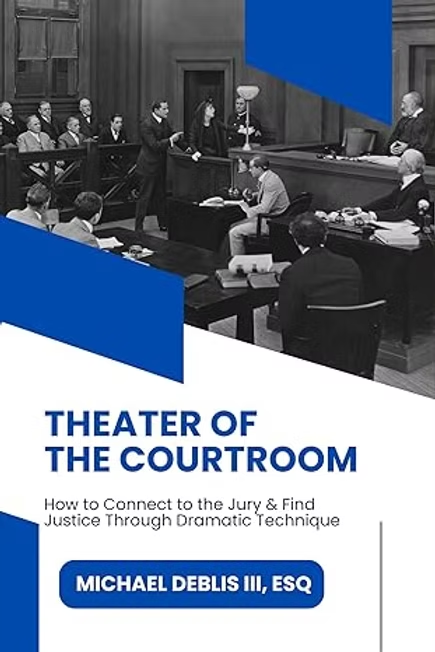
Theater of the Courtroom: Connecting to the Jury and Finding Justice through Dramatic Technique

dated: Aug 12, 2025

At first blush, the similarities between the theater and the courtroom might seem as disparate as the difference between the lightning bug and the lightning. But when you look beneath the surface, the connections between the two are strikingly similar.


At its core, theater is rooted in the idea that “art expresses human experience.” The same is true for trials. The very essence of a trial is a story — the story of a human experience. The goal of the attorney is to draw the jury into a re-constructed reality of past events such that they “see” what happened even though they were not present to witness the original event.


The attorney is the producer of that event as well as the writer, director, and the actor in that event. A play is also a live event with story at its core. The goal of the actor is to transform personal experience into a universal and recognizable form of expression that has the ability to change something in the spectator. Actors must guide the audience on a journey bringing with them their minds and hearts.


I’ve become fascinated with how the creative world of acting overlaps with the courtroom and how the connections between these two disciplines can be exploited for the good of my clients. This has become my life’s work. It has ignited something inside me. It exhilarates me in ways that I cannot describe. Come join me on this wild ride.

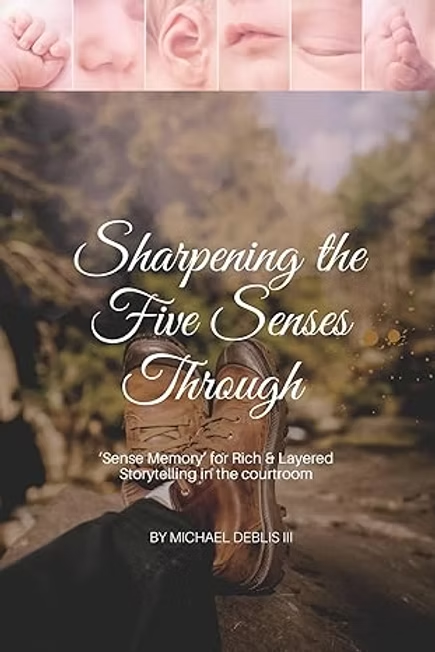
Sharpening the Five Senses through “Sense Memory” for Rich and Layered Storytelling in the Courtroom

Updated: Aug 12, 2025

To be captivating storytellers, we need to learn to use the five senses when telling our client’s story. The five senses are taste, touch, smell, sight, and hearing. This is how we take in and perceive the world around us. Today, our senses are not as honed as that of our earlier ancestors. After all, they were hunters and gatherers who had to learn how to survive extreme outdoor conditions with carnivorous predators lurking everywhere. One false step and they would be the main entree for a four-legged predator.

This ebook will give you several practical exercises for reconnecting with your five senses, re-sensitizing them, and then rediscovering the beauty of the world around you through a narrower and more focused lens. This will help you to tell your client’s story with detail, clarity of thought, and “cliff-hanging” suspense in order to win the minds and hearts of the jury.

Click here to purchase this ebook on Amazon

From Jury to Judgment: A Modern Guide to Storytelling Strategies for Courtroom Success

As a trial lawyer, what do you really need in order to win your case? Attention — the jury’s attention.


I don’t mean that in the narcissistic “everyone look at me” sense. When I say every trial lawyer wants more attention, what I mean is that before you can build a rapport with the jury and earn their trust, you have to fight a war — the war for the jury’s attention. “Attention” and “connection” are the key elements needed to win the minds and hearts of the jury.


Like it or not, we are in the midst of an attention war. We need to confront the reality that the jury’s attention can no longer be taken for granted. We have to change our way of thinking to focus on gaining attention before we can leave lasting impressions.


The jury’s attention must be the currency that every trial lawyer trades in. In this presentation, I will talk about how storytelling can help lawyers to cut through all of the noise and distractions of everyday life in order to connect to the jury on a human level.


This ebook will change the way you see the courtroom. Hold onto your hats and get ready for a wild ride.

The Field Beyond Right and Wrong: Embracing Authenticity in Law and Life

In today’s world, we are so obsessed by how we are perceived by others. Our personas reflect this. In fact, we spend such a disproportionate amount of our lives trying to imitate our role-models that we don’t even know ourselves. As they say, “Imitation is the sincerest form of flattery.” Or is it?

In my opinion, before we can get serious about self-awareness, we need to have self-acceptance. And therein lies the problem. We are so deeply insecure of being ourselves. We don’t think that we are attractive enough, smart enough, or worthy enough — and so we spend our lives trying to prove to others what we’ve never learned to believe about ourselves.

When you stop and think about it, we are the only species on the planet that aspires to be like someone else. But a rabbit doesn’t try to be like a lion. Nor does a horse try to be like a bird. They are authentically themselves in their purest and most original forms – just as nature intended them to be.

Authenticity has become a huge theme in popular culture today. It gets celebrated in the performance industry when an actor of the likes of Viola Davis, Al Pacino, or Leonardo DiCaprio gives an Emmy-winning performance. These accolades are certainly well-deserved. But it is important to recognize that it is not all glitz and glamor.

Authenticity requires courage. Why? Because it’s polarizing. You will not always be nice. You will not always be liked. You may even be hated. For this reason, the connections between authenticity and the courtroom are as undeniable as the link between truth and justice themselves. At some point in your career, even if you have not done so already, you may find yourself representing a client who has committed a heinous act or standing up for a cause that is wildly unpopular in the court of public opinion. Such circumstances are a far cry from the solitude of taking a Sunday afternoon stroll through the park with your dog. Indeed, zealous advocacy by its very nature is inherently confrontational.

The sacred oath that we, as lawyers have to our clients is monumental. It requires deep-seated courage, along with a profound and enduring inner strength that is firmly rooted within the lawyer’s character. It suggests a resilience that isn’t temporary but is an ingrained part of who we are. Profound as it may be, it goes beyond that of an ordinary person.

A great metaphor is a mango. Who could resist that tropical fruit with a thin, waxy skin and sweet, aromatic, yellow-orange flesh? Many. In fact, billions. At the same time, it is utterly attractive to the right set of people. The mango has learned to accept this reality instead of spending its entire life trying to win the approval of everyone else on this planet who dislikes it, which is itself a losing battle.

Evolution has made it impervious to universal approval, concerned only with thriving in its own environment and appealing to those creatures that help it grow and spread. It doesn’t apologize for its flavor or change its essence to suit every palate—it ripens, it offers, and it endures.

A powerful source of inspiration for embracing authenticity comes from analyzing it from the opposite end of the spectrum – from the perspective of wanting to play it safe and blending in versus daring to stand out and be seen for who you truly are. One path offers comfort but stagnation; the other, risk but liberation. In this way, they are like strange bedfellows.

The expression, “A jack of all trades and a master of none” immediately comes to mind. Let’s face it. If you spend your entire life trying to win the approval of everyone, you may never win the approval of anyone. To me, I would rather have a band of critics than be a cardboard cutout of myself — praised for perfection but hollow of truth, a veritable “milk toast” version of who I really am.

Many insist that they are authentic in their own lives. And I have no reason to doubt it. However, there is a difference between authenticity in everyday life and authenticity in the performance space, especially public speaking. The latter requires an even deeper level of authenticity that I like to refer to as, “radical authenticity.”

Just like actors need to be radically authentic on stage or on camera to embody the character they are playing, lawyers must be equally authentic in the courtroom to embody credibility — grounded in truth, conviction, and a genuine connection to the story they are telling. Then and only then will they create the kind of connection with the jury that transcends logic and touches something deeper — a sense of trust, empathy, and shared humanity that no amount of rehearsed persuasion can replicate.

As an actor, I can say unequivocally that it takes a lot of training to be authentic on stage. However, there is a misconception as to the purpose of that training. Actors train not to become perfect. After all, there is no such thing as perfection. It is nothing more than an illusion. Instead, actor training focuses on stripping away the obstacles and self-imposed barriers that convince actors they are not already perfect the way they are. This allows their true and imperfect selves to shine through with the radiance of 10,000 wax candles. For this reason, actor training can serve as a powerful and transformative tool for trial lawyers.

Because failure is inherent in performance, the actor slowly develops the muscle of failing without beating themselves up for it. Instead of caring so much, they care just enough. Because everyone is at a different stage in their journeys, every actor starts from where they are when they walk through the door. With each small step, they learn to trust themselves, to love themselves, and to fully invest in themselves.

As Rumi, the 13th-century Persian poet and theologian once said, “Out beyond our ideas of right and wrong, there lies a field. I’ll meet you there.” Meeting in that “field beyond right and wrong” reminds us that true connection—whether with others, with a jury, or with ourselves—requires moving past judgment and embracing openness.

In law, as in life, it is only when we step into that space of curiosity, empathy, and authenticity that we can communicate with real power and integrity, leaving behind the constraints of fear and pretense. For more on this and other topics that straddle the courtroom and the stage, check out my ebooks.