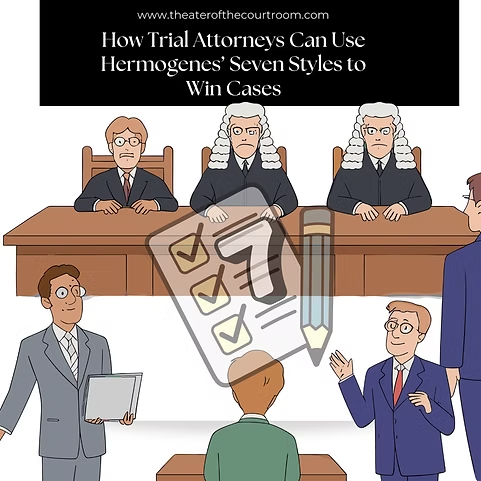
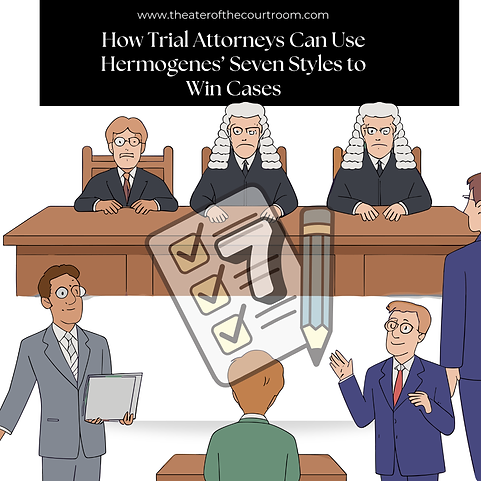
Hermogenes’ Seven Styles describe distinct energetic qualities of speech. In the courtroom, these become strategic tools for shaping juror perception, guiding emotion, and controlling meaning. Each style is a mode of influence, and great advocates move fluidly between them. Below is each style and how it functions powerfully for trial lawyers.
1. Clarity
Purpose: Make the story easy to follow. Remove confusion. Build credibility.
Where to use it:
- Opening statements
- Fact summaries
- Timeline and sequence descriptions
- Redirect after a messy cross
Courtroom effect:
Jurors relax, trust the speaker, and feel oriented. A juror who understands you is a juror who can vote for you.
Example in action:
“At 7:42 a.m., the truck ran the red light. One minute later, the crash occurred.”
2. Grandeur
Purpose: Give moral weight and seriousness.
Where to use it:
- Describing wrongdoing
- Emphasizing stakes
- Delivering peak moments in closing
Courtroom effect:
Raises the importance of the case. Jurors feel the gravity of their decision.
Example in action:
“This was not a simple mistake—it was a choice that endangered every person on that road.”
3. Beauty
Purpose: Elevate language to inspire, move, or dignify.
Where to use it:
- Humanizing your client
- Describing loss, love, or life value
- Artful framing in opening or closing
Courtroom effect:
Creates emotional lift and admiration. Jurors feel the humanity of the client.
Example in action:
“He woke every morning with one purpose—to care for the family he cherished.”
4. Verity (Sincerity)
Purpose: Convey authenticity, moral truth, and integrity.
Where to use it:
- Addressing weaknesses in your case honestly
- Repairing credibility
- Moments requiring transparency
Courtroom effect:
Builds trust. Jurors forgive flaws when honesty is felt.
Example in action:
“You will hear something difficult about my client. You deserve to hear it from me first.”
As Gerry Spence once said, “A concession coming from your mouth is greater than an exposure coming from your opponent’s.”
5. Vehemence / Force
Purpose: Attack wrongdoing; expose lies; apply pressure.
Where to use it:
- Cross-examination
- Impeachment
- Highlighting contradictions
Courtroom effect:
Intensity focuses the jury’s moral attention and exposes the opposition’s weakness.
Example in action:
“You knew it was dangerous. You ignored the risk. And you did it anyway, didn’t you?”
6. Ethos (Character / Moral Presence)
Purpose: Display character, wisdom, fairness, restraint.
Where to use it:
- Speaking with judges
- Addressing jurors respectfully
- Challenging witnesses without overreaching
- Establishing yourself as the trustworthy voice in the room
Courtroom effect:
Jurors bond with the attorney. Ethos is often the decisive factor in close cases.
Example in action:
“We seek only what is fair—and nothing more.”
7. Vigor / Rapidity
Purpose: Use pace, momentum, and rhythm to energize the narrative.
Where to use it:
- Driving home a point in cross
- Rapid-fire logic in closing
- Showing momentum of facts lining up
Courtroom effect:
Creates the feeling of inevitability—“It all adds up. The truth is obvious.”
Example in action:
“He said one thing. The records show another. The video confirms the truth. And the truth is simple.”
How the Seven Styles Combine in Courtroom Persuasion
Great trial lawyers blend these styles throughout the arc of the trial:
Opening Statement
- Begin with Clarity to orient the jury
- Add Beauty to humanize the client
- Use Grandeur to raise moral stakes
- Employ Ethos to build trust
Direct Examination
- Use Clarity and Ethos to make witnesses believable
- Add Beauty when telling your client’s story
Cross-Examination
- Use Vehemence to expose contradictions
- Use Rapidity to build momentum
- Use Clarity to land your points cleanly
Closing Argument
- Start with Clarity
- Build into Grandeur
- Use Verity to show honesty
- Lift the jury with Beauty
- Finish with controlled Force and high Ethos
The attorney becomes a master of stylistic modulation, keeping jurors engaged, morally anchored, and emotionally attuned.
Why This Wins Cases
Hermogenes believed the Seven Styles let a speaker “command the souls of listeners.”In modern terms:
- Jurors remember structure (Clarity).
- They feel moral weight (Grandeur).
- They bond emotionally (Beauty, Ethos).
- They respond to intensity (Vehemence).
- They feel momentum and logic (Rapidity).
- They trust honesty (Verity).
When used consciously, the Seven Styles give trial lawyers not just persuasive language—but complete mastery of courtroom presence.
Here is a one-page trial advocacy reference sheet. Use this sheet as a diagnostic tool: if a moment isn’t landing, the issue is often stylistic—not substantive.
The Seven Capital Styles
Adapted from Hermogenes for courtroom use
1. Clarity
Purpose: Make facts and logic unmistakable.
Use When:
- Openings (storytelling, timelines)
- Direct examination
- Explaining exhibits or procedures
Courtroom Effect: Jurors understand exactly what happened and why it matters.
Advocacy Tip: Short sentences. Concrete nouns. Chronological order.
2. Grandeur
Purpose: Convey moral weight, seriousness, and importance.
Use When:
- High-stakes moments in opening or closing
- Framing injustice, harm, or responsibility
- Speaking about community standards
Courtroom Effect: Elevates the case beyond details to meaning.
Advocacy Tip: Slow pace. Fewer words. Let silence work.
3. Beauty
Purpose: Create harmony, balance, and aesthetic pleasure in speech.
Use When:
- Humanizing your client
- Describing loss, dignity, or ordinary life
- Building rapport with jurors
Courtroom Effect: Makes the lawyer and client likable and trustworthy.
Advocacy Tip: Natural rhythm. Avoid sounding rehearsed.
4. Rapidity
Purpose: Generate momentum and urgency.
Use When:
- Cross-examination
- Locking in concessions
- Driving home a factual sequence
Courtroom Effect: Creates pressure and limits evasion.
Advocacy Tip: One fact per question. Keep moving.
5. Character (Ethos)
Purpose: Establish credibility, fairness, and moral reliability.
Use When:
- Addressing sensitive issues
- Acknowledging weaknesses
- Building trust early with the jury
Courtroom Effect: Jurors believe you before they believe your argument.
Advocacy Tip: Sound reasonable—even when you are firm.
6. Truth / Verity
Purpose: Signal honesty, simplicity, and authenticity.
Use When:
- Key factual admissions
- Explaining what your case is not
- Correcting exaggeration or spin
Courtroom Effect: Cuts through rhetoric and feels real.
Advocacy Tip: Plain language. No flourish.
7. Force
Purpose: Apply pressure, confrontation, and decisive impact.
Use When:
- Impeachment
- Highlighting recklessness or indifference
- The turning point of closing argument
Courtroom Effect: Creates moral clarity and demands judgment.
Advocacy Tip: Control intensity—force comes from precision, not volume.
How Great Trial Lawyers Use the Styles
- Openings: Clarity → Beauty → Grandeur
- Direct Exam: Clarity + Ethos
- Cross Exam: Rapidity + Force
- Closing: Verity → Grandeur → Force
Key Principle: Jurors are persuaded not by one style, but by the right style at the right moment.